
Jensen FF Chassis 119/004 | The Italian Job
The Museum’s Vignale Jensen FF, 119/004, has been under the knife. The UK-based specialist Jensen firm of Rejen , run by brothers, Jason & Paul Lawrence, were given over the car for a complete retrim back to its original specification.
It would be major surgery on the Museum’s earliest Vignale FF, with months of initial discussions leading to a trim restoration Italian style. The trim restoration would turn out to be mid-century archeology at its finest.
Jensen FF Chassis 119/004 | The Italian Job | Back to the 1990s
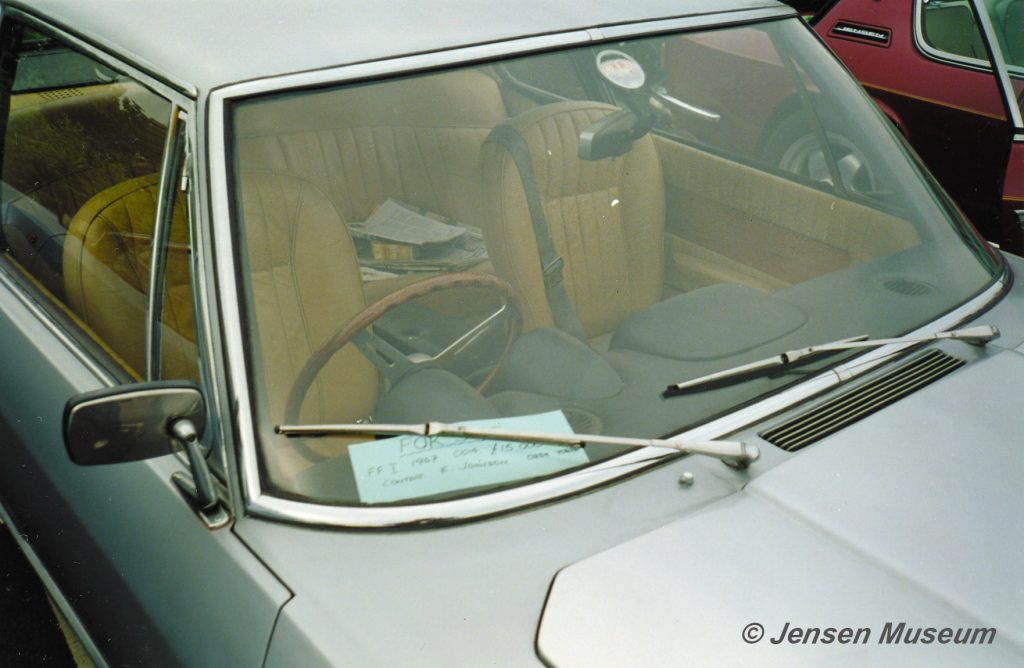
119/004 photographed in 1992.
Purchasing 119/004 in 1992, the new owner, Martin Whiffen immediately placed the FF with Cropredy Bridge Garage. The FF was to have a full and comprehensive restoration to concours standard. Whiffen made it clear to Cropredy Bridge Garage that all the Vignale panelwork was to be repaired not replaced.
All other minor build nuances of Vignale were also to be retained. Whiffen relented, however, on one rather important point, and that was the leather interior trim. Vignale had trimmed 119/004 in a specific light tan brown shade of leather.
Whiffen was not at all keen on the colour, and took the decision to have the entire leather trim replaced in a magnolia Connolly leather.
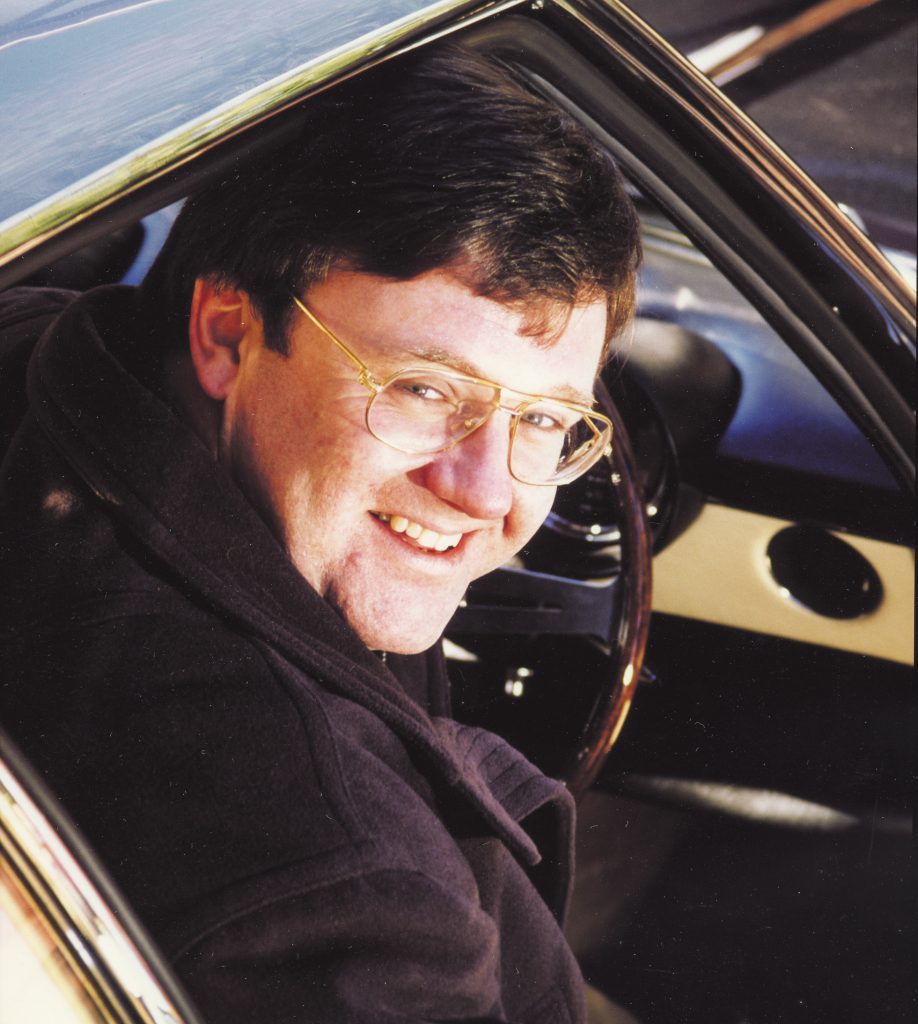
Martin Whiffen sitting in 119/004.
It was an unfortunate decision, since the original tan leather was in restorable condition. Eric Ward, one of the original trimmers from Jensen Motors, and recently retired from Jensen Cars Ltd, was charged with undertaking the retrim.
With the interior retrimmed in its new magnolia covered leather, it certainly looked impressive. Unfortunately, as with almost every retrim, the original leather was discarded as waste by Ward.
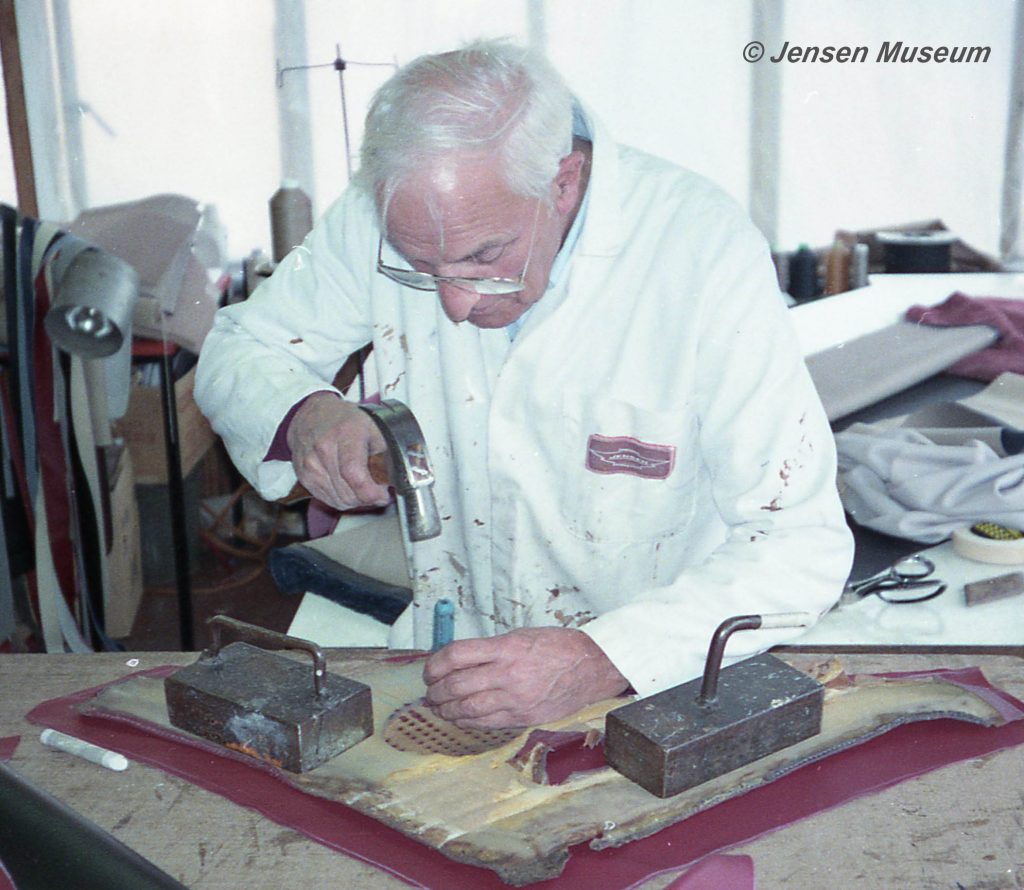
Eric Ward at work, photographed by Woodhams in 1992.
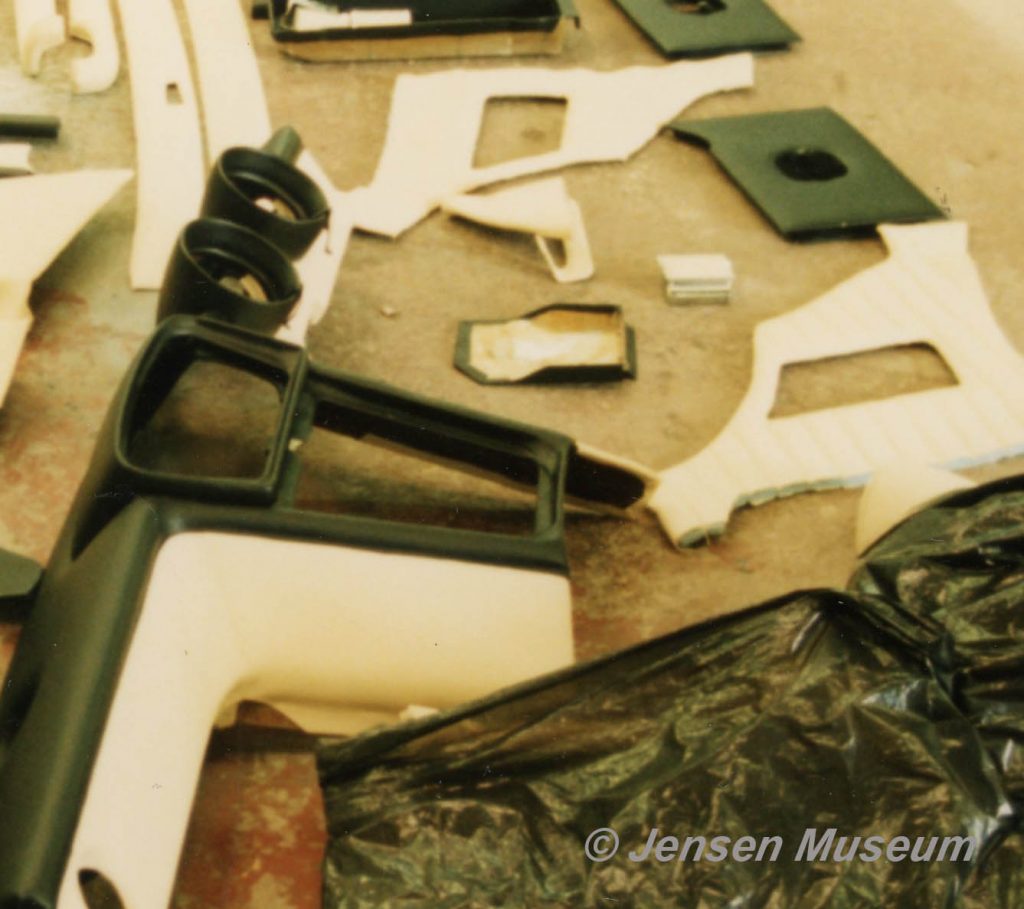
Some of the retrimmed parts for 119/004 completed by Ward.
There was no doubt that when 119/004 was finally finished, it looked quite stunning. Entering 119/004 into the Jensen Owners’ Club concours in 1995, led Whiffen to walk away with the Best of Jensen FF, and the coveted President’s Cup.
Jensen FF Chassis 119/004 | The Italian Job | Museum ownership
The Museum acquired 119/004 from Whiffen in 2006. The car remained in generally excellent condition, but there was certain aspects to be initially dealt with. Such as a modern set of radial tyres which Whiffen had fitted to the car, along with wider Rostyle wheels. The wheels were changed for the correct factory size, and the radial tyres were changed for a set of period style crossplys.
However, as far as Woodhams was concerned, on the long term, the magnolia trim needed to be removed, and the car returned to its original Vignale factory appearance, with a tan leather trim.
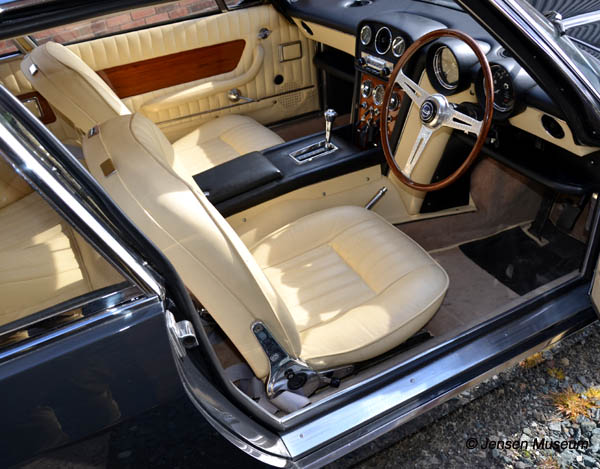
The interior of 119/004 photographed in 2016.
Jensen FF Chassis 119/004 | The Italian Job | Not just another Retrim
During 2016, Ulric Woodhams of the Jensen Museum, entered into discussions about retrimming 119/004. The discussions took place with Jason Lawrence of the the Hampshire-based Jensen specialists, Rejen.
The Company were well known for their sympathetic trim work on Jensen cars. In particular, the way they took on board all the nuances of the way the cars were trimmed at Jensen Motors. In fact, they held all the original wood templates originally used by the Jensen factory.
However, 119/004 was something completely different. Having been built and trimmed at Vignale in Italy, meant the materials, and the way everything was trimmed, was subtly different to how trimming was achieved later on at Jensen Motors.
To the uninitiated, if you put a Vignale trim next to a West Bromwich trim, they would look virtually the same, apart from some obvious differences such as the veneer trims set in the doors. But, there are a multitude of minor trimming differences.
The question was, by using original old Vignale spare trim parts, which Rejen had in their second-hand parts department, and some held by the Museum, could they re-trim 119/004 putting in all the nuances of Vignale trim work. Lawrence believed they could.
Now it was left to source the correct materials for the retrim. But, with the entire interior retrimmed in magnolia, and the original trim discarded some two decades previously, the major hurdle would be to find tan leather to match an original that was no longer in place.
Woodhams had been in contact with Barry Taplin, the then Australian-based owner of the Vignale-made Jensen FF, 119/007. The only other Jensen FF built by Vignale with a tan trimmed interior.
Back in 2008, Woodhams mentioned the trim situation with 119/004 to Taplin, and asked if he would be willing to cut a small piece of the tan leather from underneath one of the seats, and likewise to cut a small piece of the tan vinyl from one of the carpets. Taplin was happy to do this, cut the samples from 119/007, and posted them to the Museum.
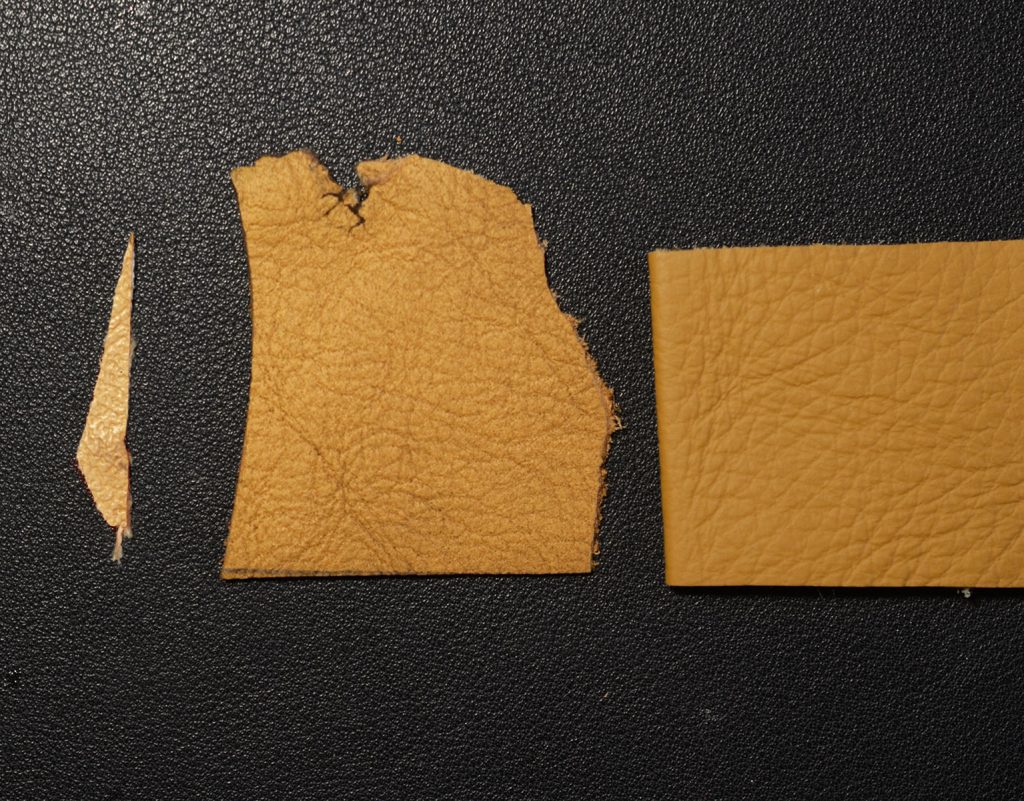
Samples of trim from Jensen FF 119/007. This was the only other Jensen FF built by Vignale and trimmed in tan. From the viewers left, a small slither of tan vinyl used to edge the carpets. Centre, a section of tan leather cut from under one of the seats of 119/007. Being from under the seat meant that the colour would be un-faded. Right, a sample of the tan leather sourced by Lawrence. It was as close a match as one would ever hope to find.
Now the first hurdle was jumped, we had to find a good match to the leather and the vinyl. Here, Lawrence came up trumps. One of his suppliers had a tan leather, of the exact shade, and even better, a very close grain as that used by Vignale. Likewise, Lawrence managed to source a near perfect match for the tan vinyl.
The carpet was slightly more tricky. The carpet used by Vignale had a very specific hard weave, of a type not encountered today. Despite extensive searches by both Woodhams and Lawrence, a carpet showing those exact nuances could not be found. A compromise was found, which was the closest in colour match and general look.
With all of the materials sourced, 119/004 was transported down to Rejen’s workshop, and initially placed in their showroom until a prevailing back-log of work had been completed, and work to 119/004 could start.
While 119/004 stood in the showroom awaiting its turn for work to start, Woodhams received an email from a French-based Jensen owner. Laurent Michelin, and his brother, Fabrice, had purchased two Vignale-built Sincar Interceptors.
The problem was, one of the cars had been partially stripped down, and the interior placed in storage. Unfortunately the storage conditions were less than perfect, and the previous owner had left the car partially stripped for some decades.
By the time the Michelin brothers purchased the car, the interior was just not restorable. By coincidence, the trim colour was none other than Vignale tan. The Michelins just didn’t know what to do about the trim, and wondered if by some miracle it could be renovated.
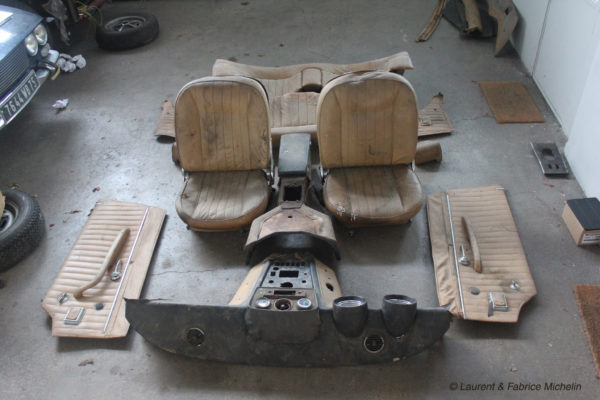
The tan leather interior from 117/2606. Unfortunately while in poor storage out of the car, the leather had gone almost rock hard. Despite initially seeing if it was possible to renovate the existing trim, the Michelin brothers reconciled themselves to the fact a re-trim was required.
It was obvious the trim set was too far gone to bring back to any satisfactory standard. So, it was outlined to Michelin that Woodhams and Rejen had already undertaken all the groundwork to retrim 119/004, and that the car was waiting to be trimmed.
More importantly all the materials had been matched, and these would be exactly the same for the Michelins interior. Excited, Michelin, contacted Rejen, and it was agreed they would retrim his interior, with Woodhams working as a consultant on the project.
There was a further consideration with the job, the Michelin brothers had a preference to the work being carried out as quickly as possible. Woodhams agreed with Rejen, that 119/004 would be rescheduled for the retrim at a later point, after the Michelin brothers retrim had been completed.
This made absolute sense, as it would give the opportunity for Rejen’s trimmers to understand first-hand, how Vignale trimmed a car. It was fortuitous both for the Michelin brothers, and for the Museum.
Jensen FF Chassis 119/004 | The Italian Job | Work Starts
With the retrim of the Sincar Interceptor 117/2606 under their belt, it was at last, time for work to start to 119/004. One of the first jobs was to remove the dashboard.
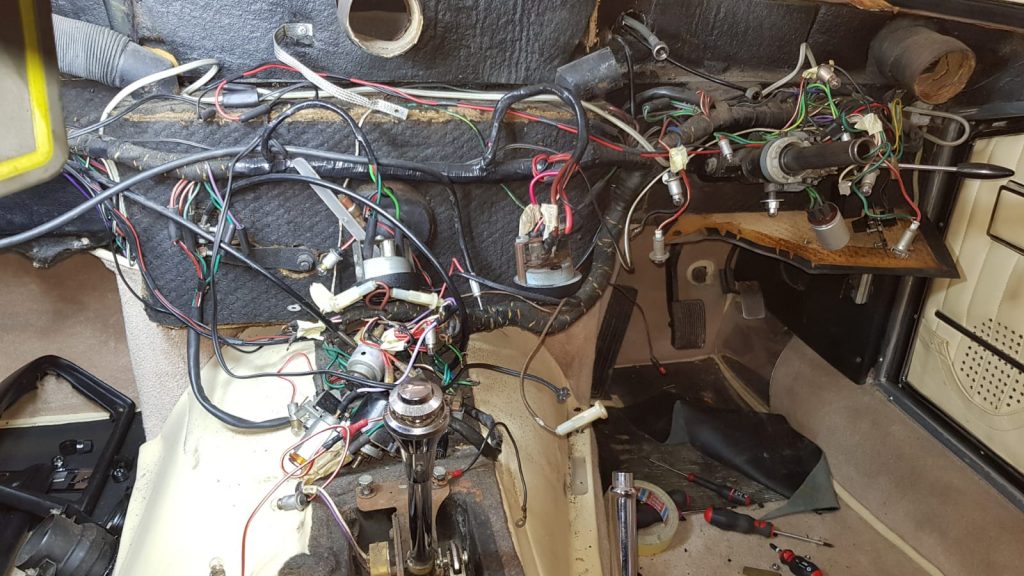
One of the first jobs, removal of the dashboard.
Re-trimming the entire MK.I style dashboard is a time-consuming affair. Lawrence felt that the black vinyl top to the dashboard looked slightly ungainly, but couldn’t understand why.
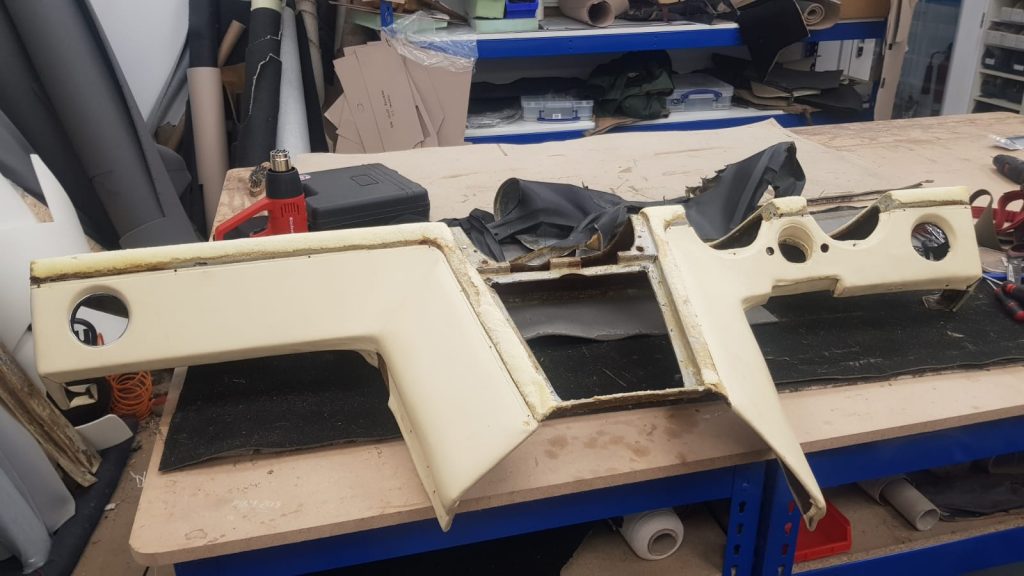
The dashboard on the bench, and the removal of the black vinyl top covering.
Once the vinyl covering had been removed, it became obvious. Rather than take off all of the original thin layer of sponge, Ward had glued another layer over the top, which then made the sponge slightly too thick. This then had an effect on the finished look of the vinyl.
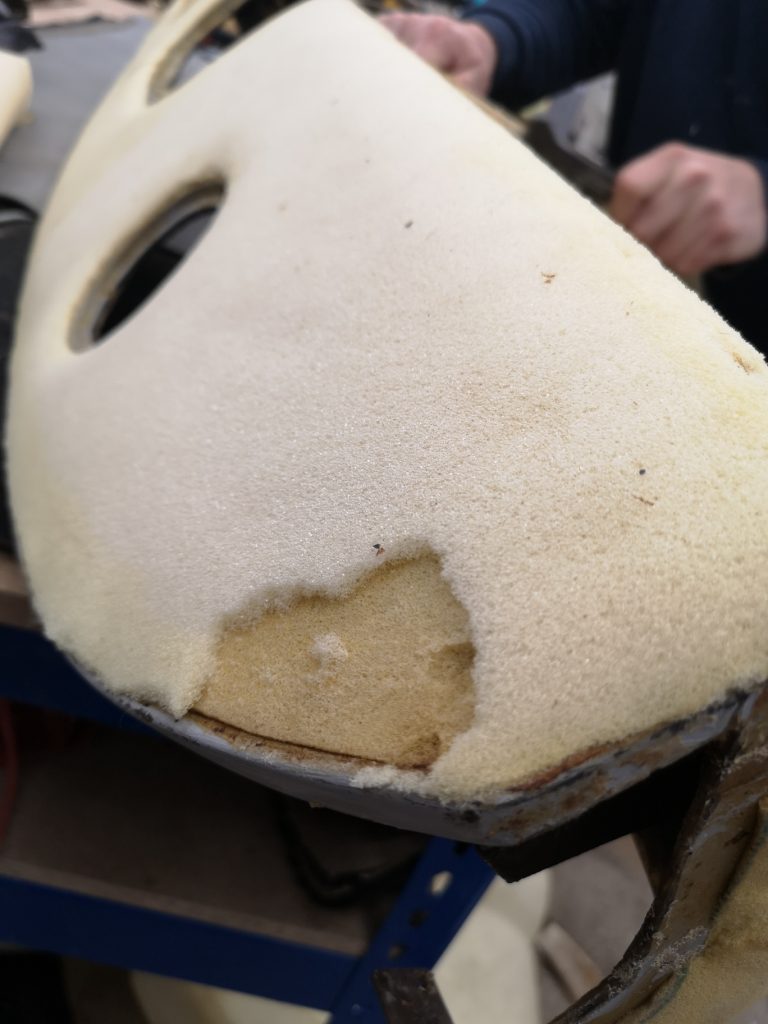
The dashboard with the vinyl top removed and showing the double layer of sponge.
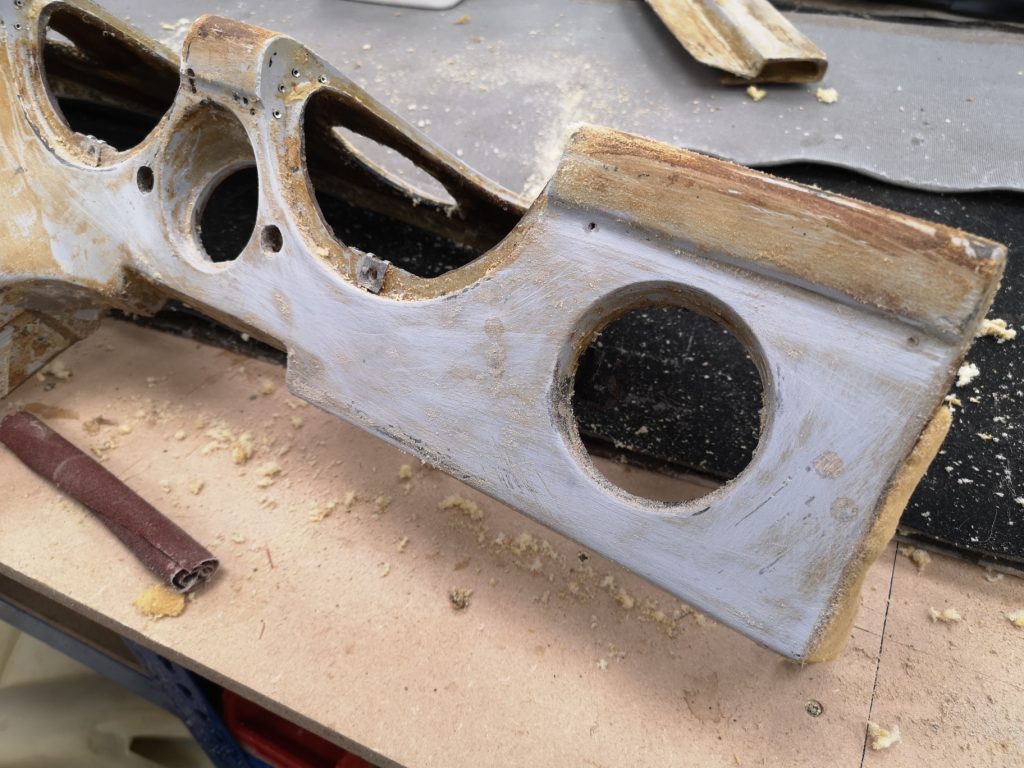
A section of the dashboard with all the materials removed.
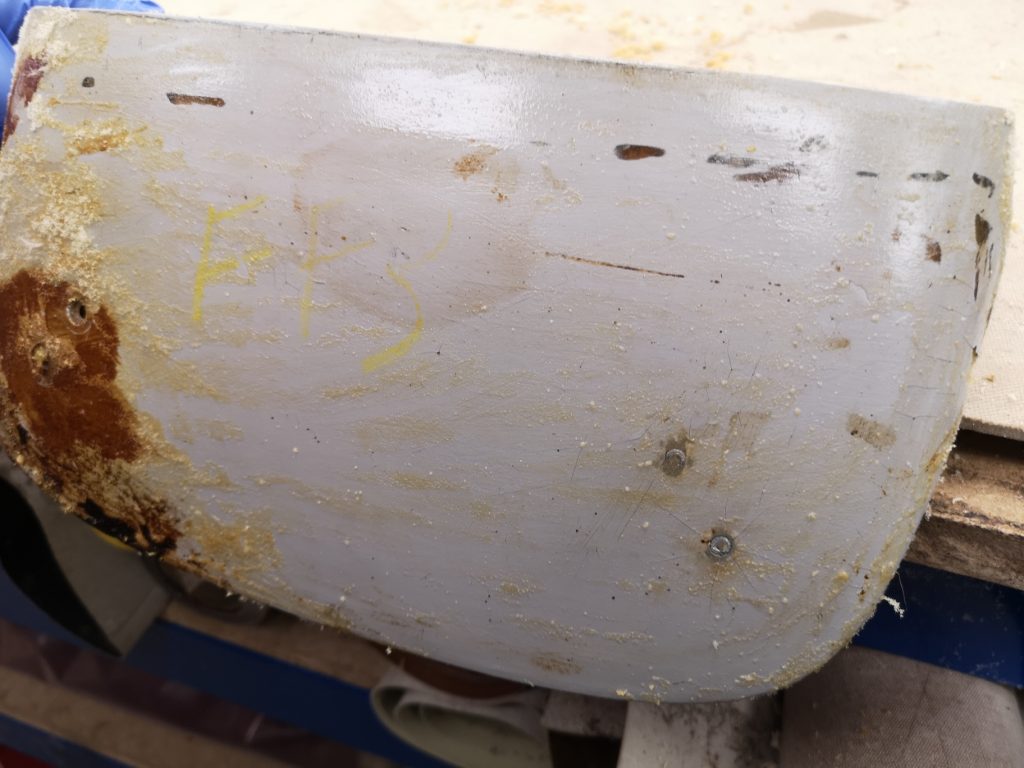
The fibreglass moulding for the radio console with all the sponge removed, and revealing Vignale’s assembly number ‘FF 3’.
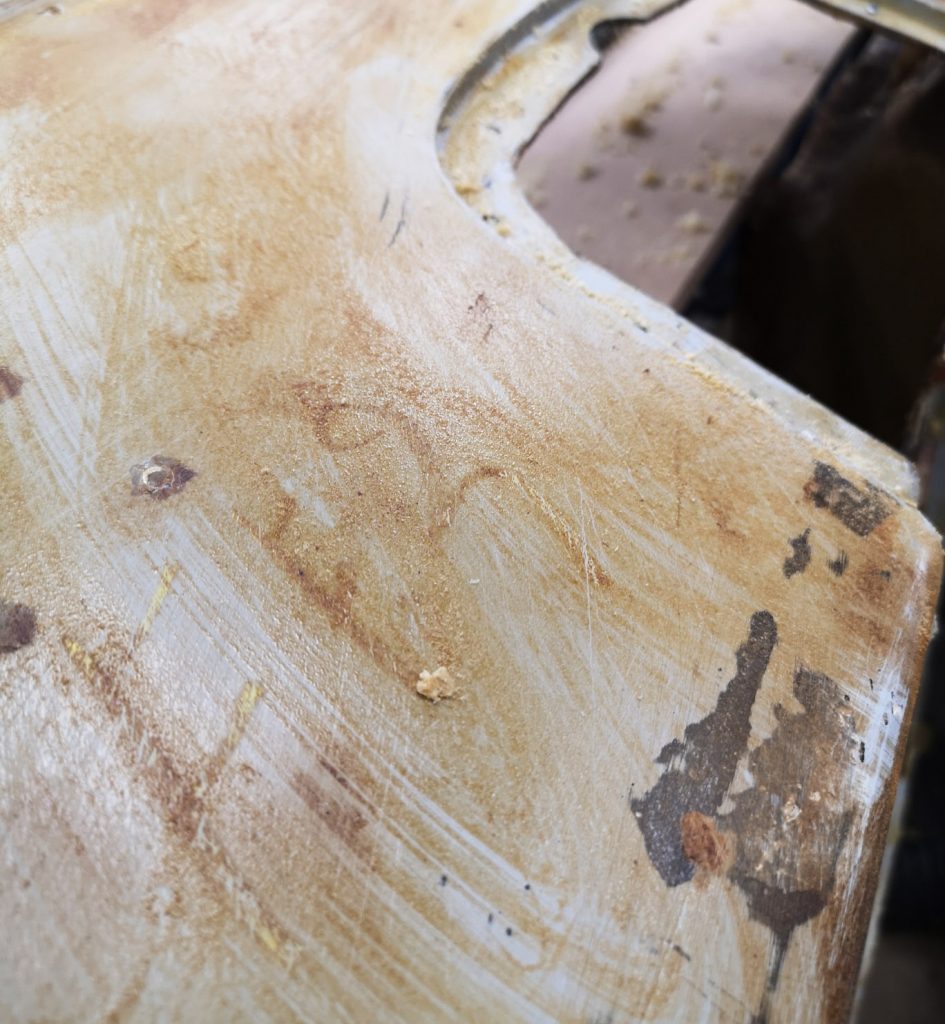
The dashboard top, cleared of sponge, revealing the Vignale designation, ‘FF 3’.
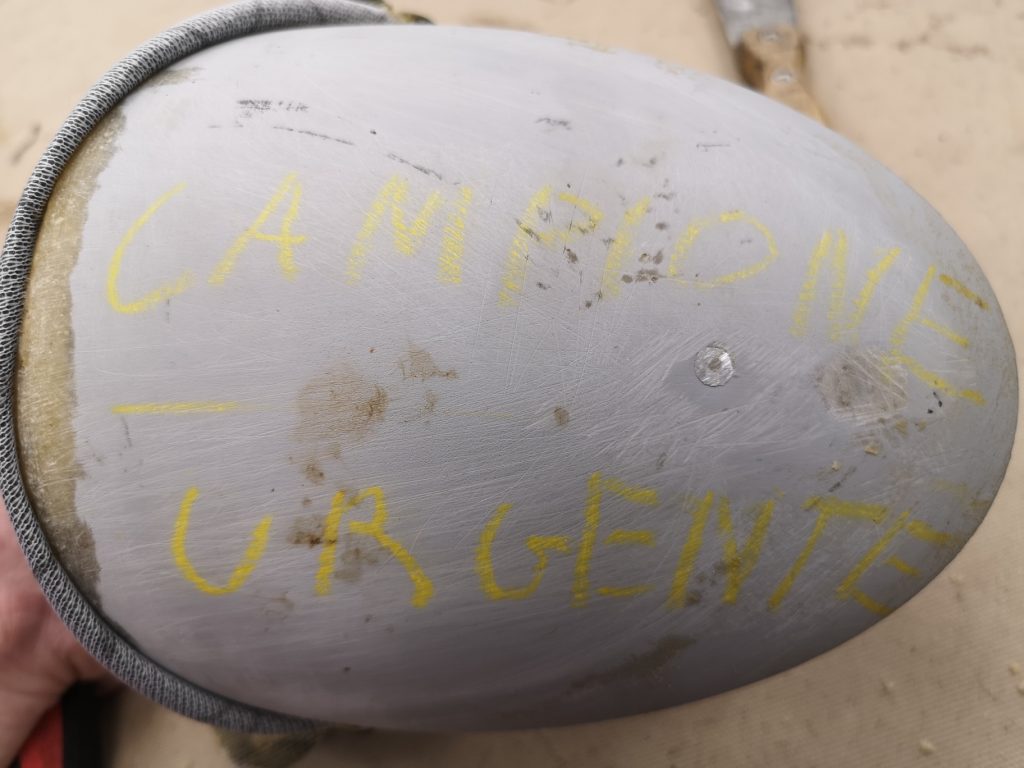
One of the cupula for the speedometer, and tachometer. With the vinyl coverings removed, both bore the Italian designation, ‘Campione Urgente’ (urgent Samples).
With all the sponge removed, the trimmers found that the top surface of the radio console was marked ‘FF 3’. This was the Vignale assembly number for the car, and meant it was the third Vignale FF built up, even although it was on the Jensen chassis number 119/004.
This often happened, as Vignale weren’t interested in what the actual Jensen chassis number was, they simply took the easiest chassis to take out of storage in readiness for building. As such, Jensen FF chassis number 119/003 was built up after 119/004, and is believed to be Vignale FF number ‘4’.
A large proportion of the trim parts of 119/004 were marked up by Vignale as ‘FF 3’, with the occasional part being marked ‘FF 4’. However, additionally a number of trim parts were marked on the backs as ‘Urgent’. Undoubtedly , this was brought about by pressure from Jensen Motors. Both Jensen FF 119/003, and 119/004 were wanted urgently.
Jensen had already pre-sold 119/003 to Harry Ferguson Research, and they wanted the car as quickly as possible for their own research and evaluation of the four-wheel-drive system.
Likewise, Sir Clive Carr, Chairman of the News Of The World Newspaper, had pre-ordered 119/004. He would be the first private owner of a Jensen FF, and wanted his new car urgently. As-Soon-As-Possible, if not earlier, was the name of the game with the first Vignale-built Jensen cars.
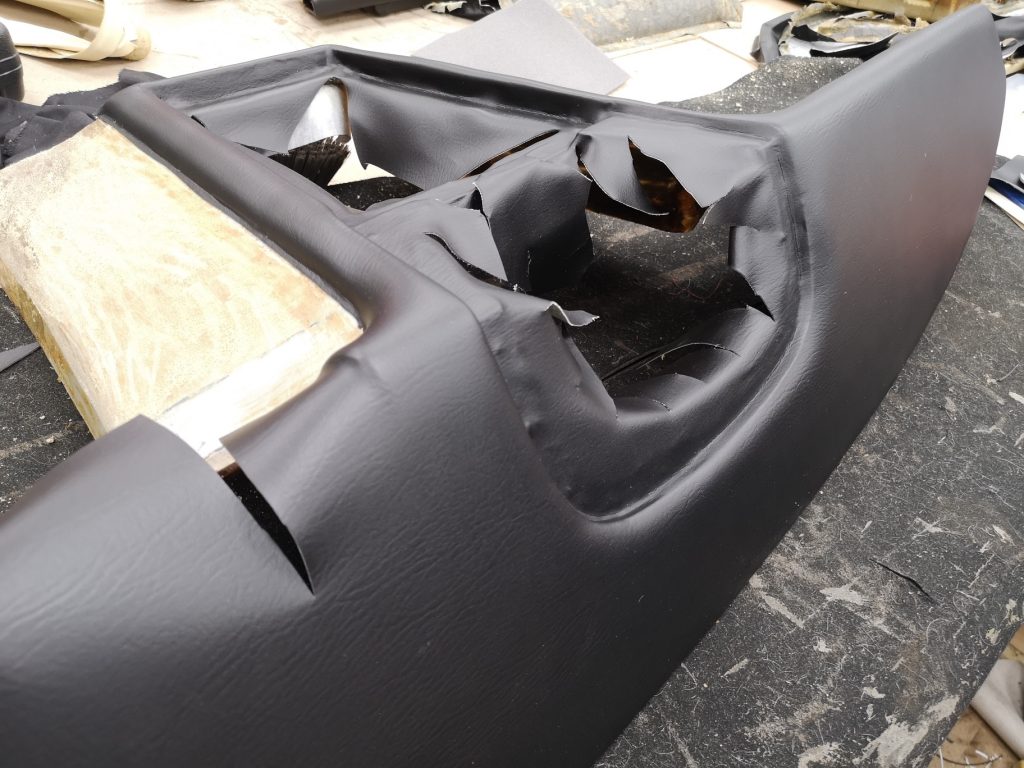
The black vinyl being manipulated into position over the top section of the dashboard.
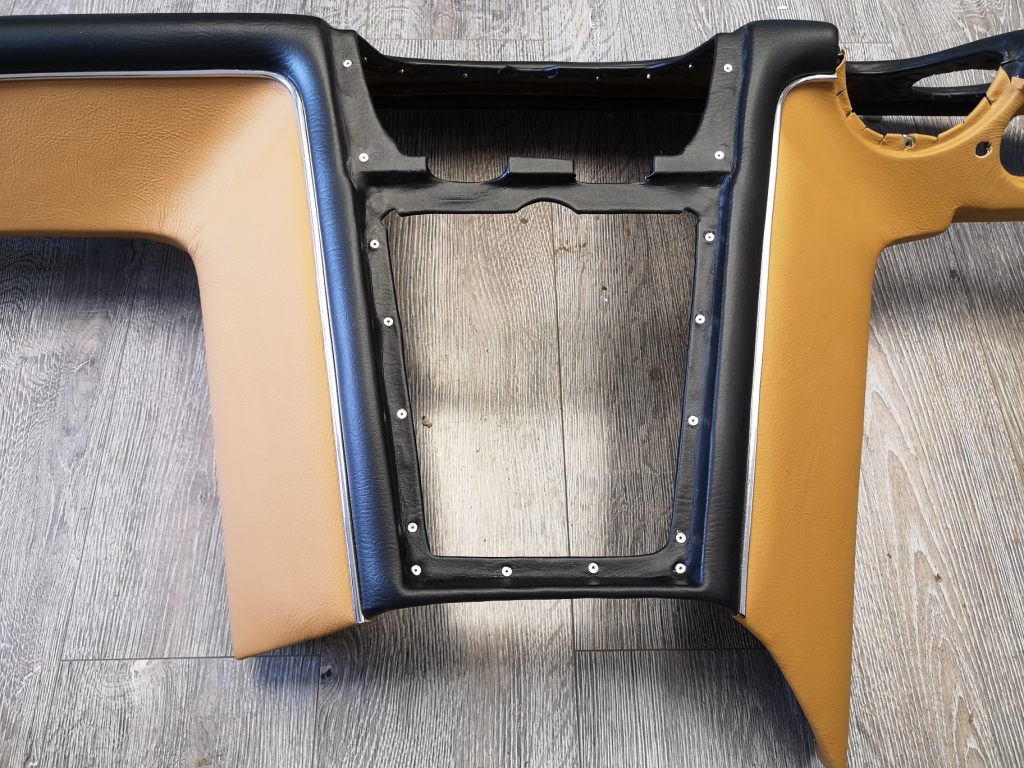
The dashboard with trimming in place. Of interest are the small rivets used to hold the black vinyl in place around the instrument panel, and radio console areas. This wasn’t generally followed through at Jensen Motors – they simply glued the vinyl into position. It is this attention to the small nuances of Vignale’s trimmers that Woodhams wanted to preserve, or put back into the trim of 119/004.
With trim work more or less finished to the dashboard, and with the main seating already out of the car, it was time to take out the main transmission cover. Once again, the trimmers would get a surprise.
As they started to take off the magnolia leather using a heat gun, they quickly realised the magnolia leather had been glued directly over the original tan leather. The trimmers worked as carefully as they could to take the magnolia leather off, and also to save the tan leather.
The glue had discoloured much of the tan coloured finish, but there was a significant amount surviving in good order. It was also found that both the side sections, that sit on top of the tunnel cover, were also covered directly over the original tan leather.
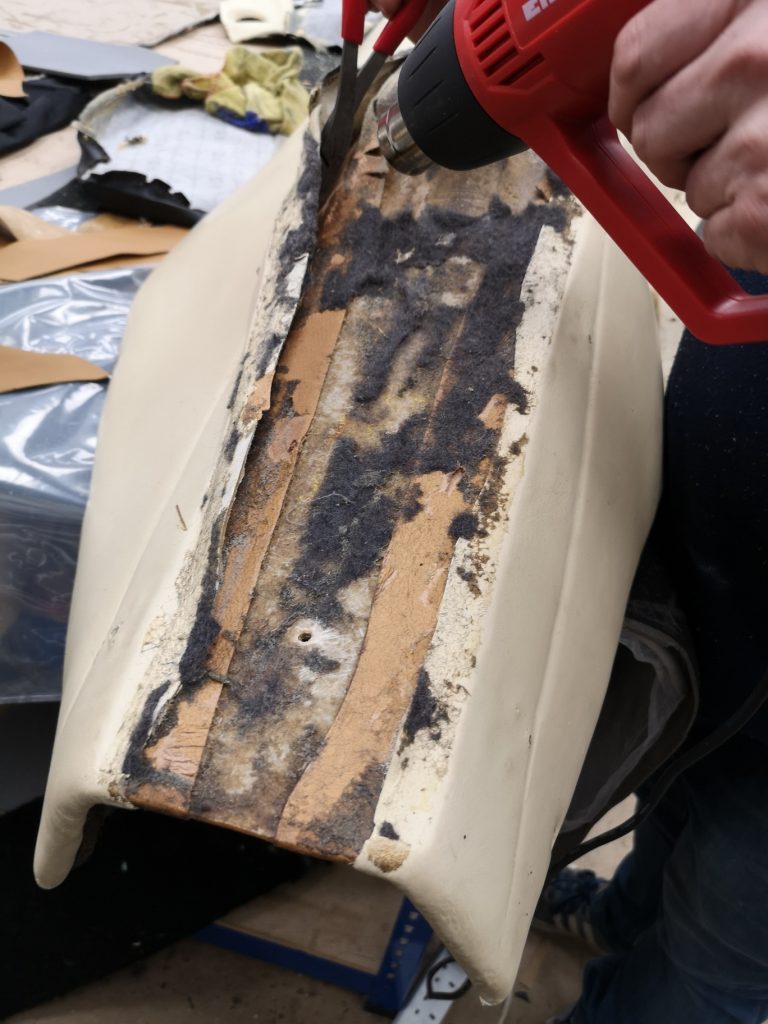
Remarkably, Ward had trimmed directly over the original Vignale tan leather on the main fibreglass transmission cover. Rejen’s trimmers removed the magnolia leather first, as carefully as they could using a heat gun. Afterwards, they removed the original tan leather.
But at least there was some sections that remained in one piece. It is the only original tan leather belonging to 119/004. It meant there was some that could be archived. This was an unexpected bonus, and Ward’s time saving escapades were greatly appreciated.
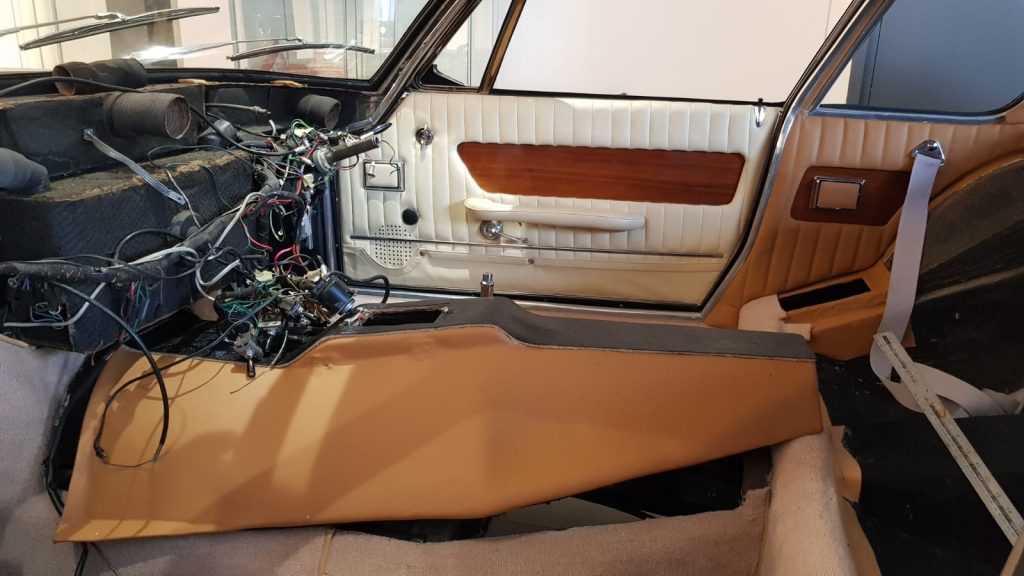
The retrimmed transmission tunnel cover being positioned back into place.
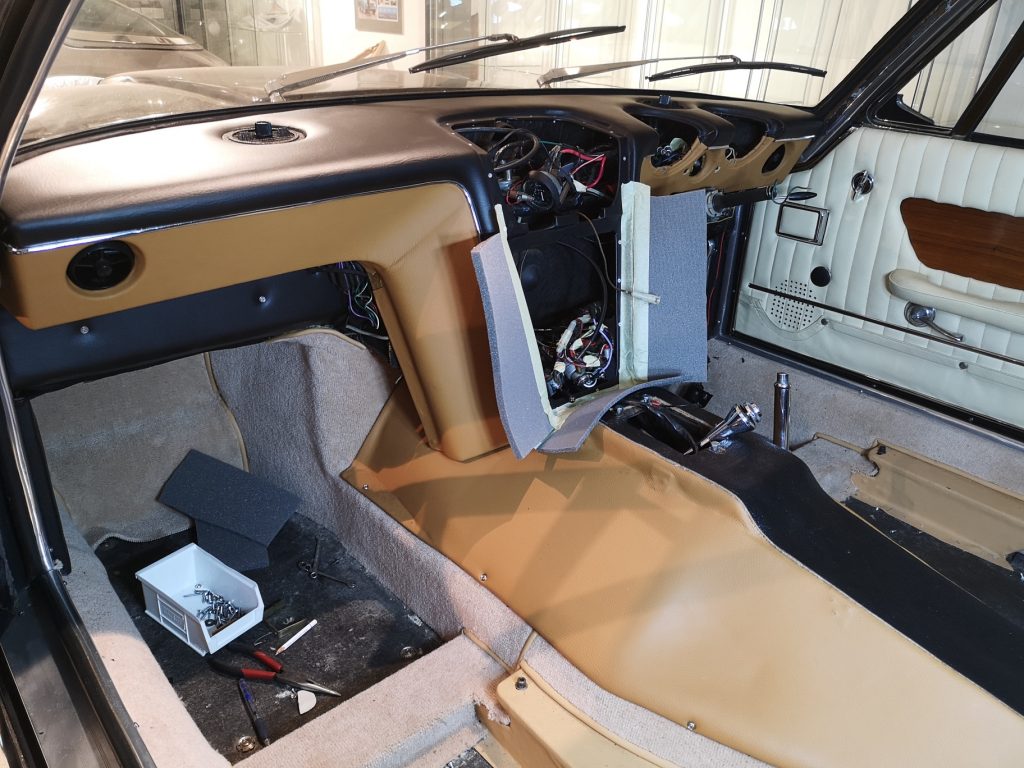
After the transmission tunnel cover was back, then the dashboard could be fitted into place.
Both the door panels and the rear quarter panels didn’t look right. Again, too much sponge had been used, so that when machine stitched with the vertical stitching lines, the strips looked slightly bulbous.
Additionally, Whiffen had also asked that the door panels should have speakers fitted. Door speakers were not fitted to Vignale-built cars, and in fact were not fitted to the initial West Bromwich built cars. It was a compromise when Whiffen asked for them to be fitted, and the speaker holes always looked incongruous to the Vignale interior.
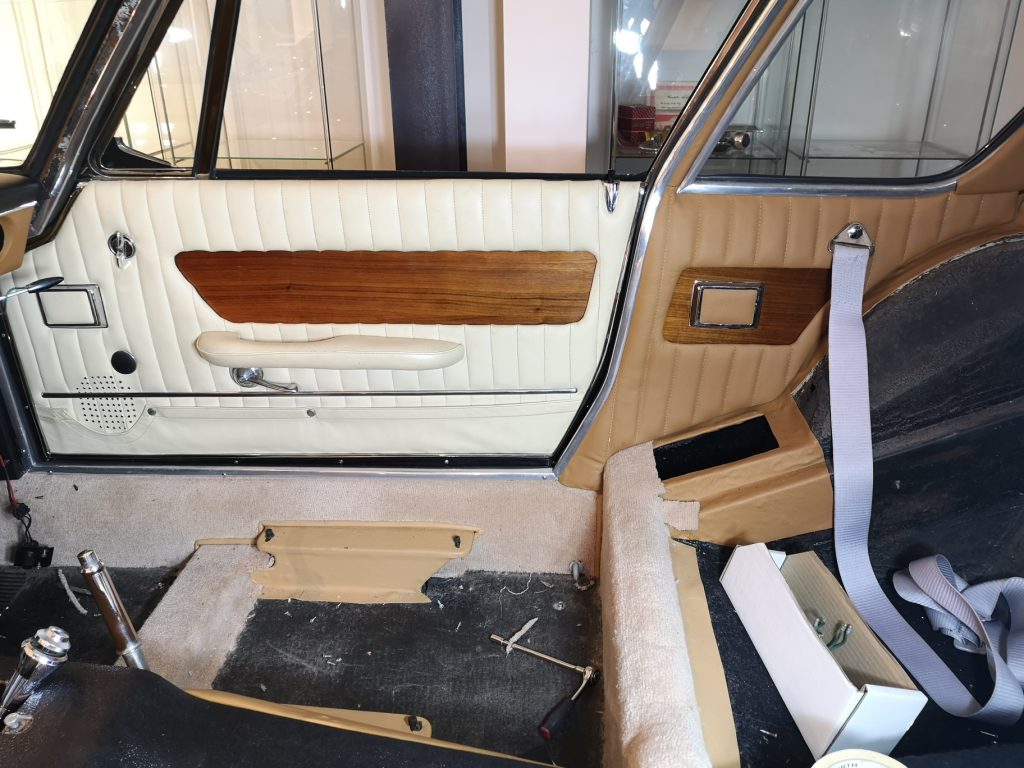
The tan trim rear quarter sections now in place, and the start of the carpeting going in. The magnolia covered door card would be next for retrimming. Note the incongruous looking speaker holes. The speakers would be removed, and the door cards would be trimmed in tan exactly as they would have come from Vignale.
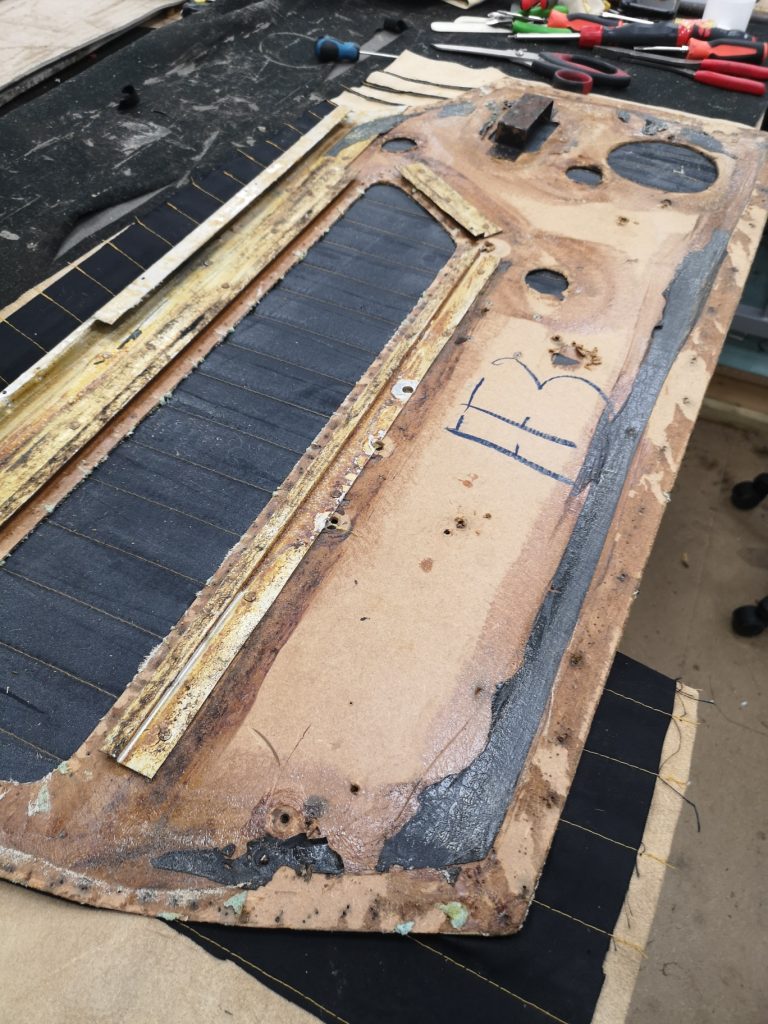
The reverse of one of the door cards. The cards were still the originals as fitted by Vignale. They remained in good condition, and we decided to reuse them. The aluminium channeled sections are where the veneer panel is slid into place. Both door cards are marked ‘FF 3’.
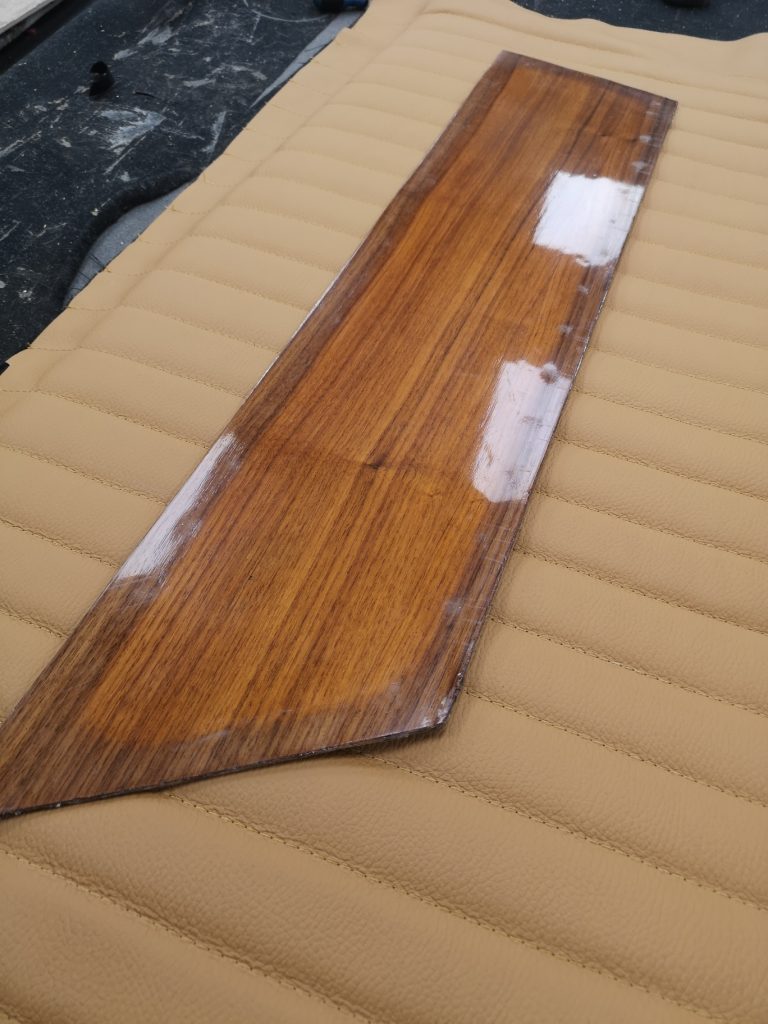
The American crown cut walnut veneer panel. Although slightly faded since the 1990s refurbishment, the varnish was in perfect order. In fact the colour had moved to a rather pleasant warm hue. It was decided to leave them as is.
With the door cards removed, and examined, it was found they were at least the original Vignale door cards (both marked ‘FF 3’). These would be retained, and with the magnolia leather removed, would be trimmed with the tan leather.
All the original Vignale veneers remained in excellent condition, including the large veneers that slotted into the door panels.
They had been refurbished back in the 1990s, and although they had faded slightly, it was decided that the level of fading was tolerable, and that it was best to leave them alone.
Interestingly, veneers specialist, Phil Cliff, of Chapman & Cliff, confirmed that Vignale used an unusual American crown cut walnut, known for its densely packed horizontal lines.
This was probably to be more modern and cutting edge – far removed from the traditional burr walnut. Back in the 1960s, Italy was the centre of the whole veneer trade, and wood came to Italy from all over the world to be cut into veneers and exported out again. Vignale would have had the optimum choice of veneer at that time.
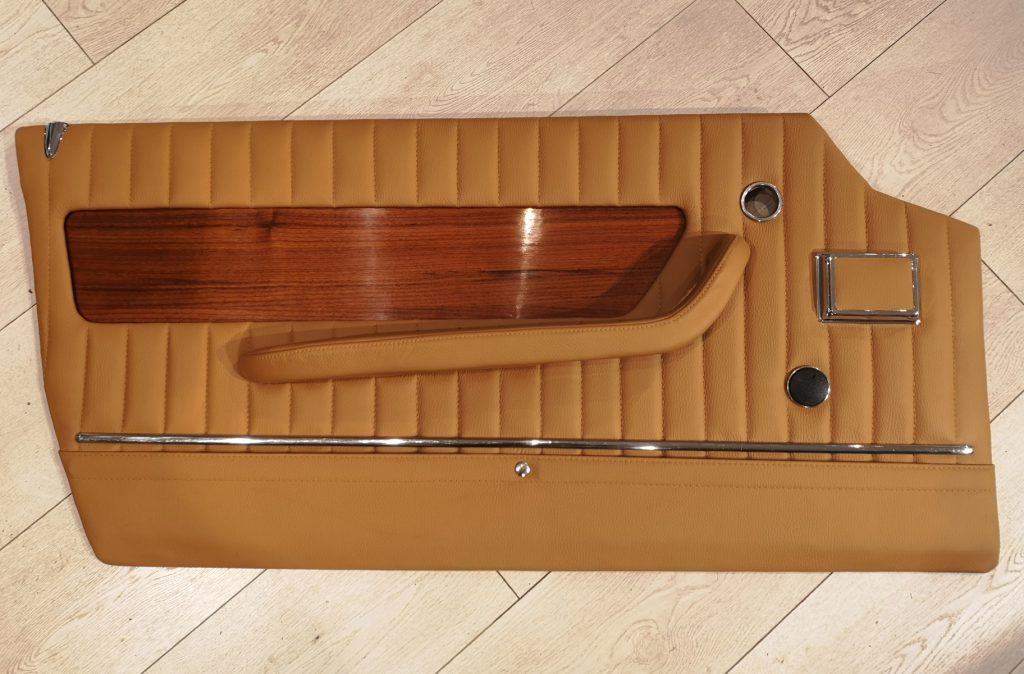
The completed door card in tan leather, and with the veneer panel slipped back into place.
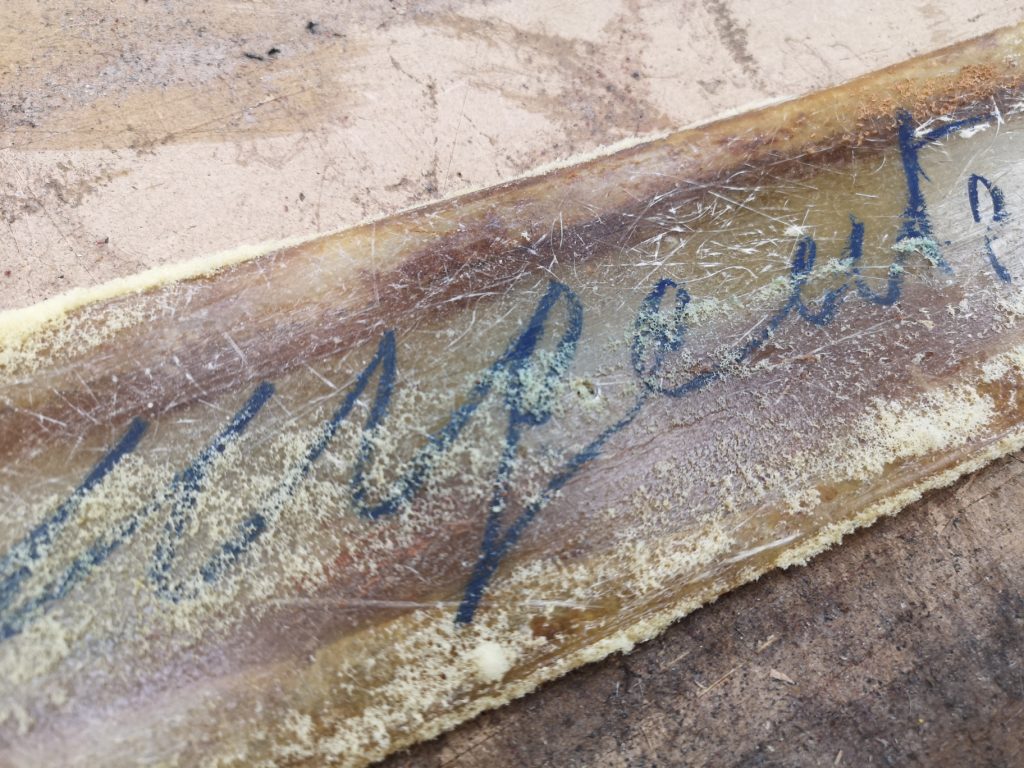
The main interior front rail by the headlining. Vignale had these made in fibreglass, but when production started at West Bromwich, they changed from fibreglass to a moulded cardboard. This piece bears the designation, ‘Urpeute’, i.e ‘Urgent’.
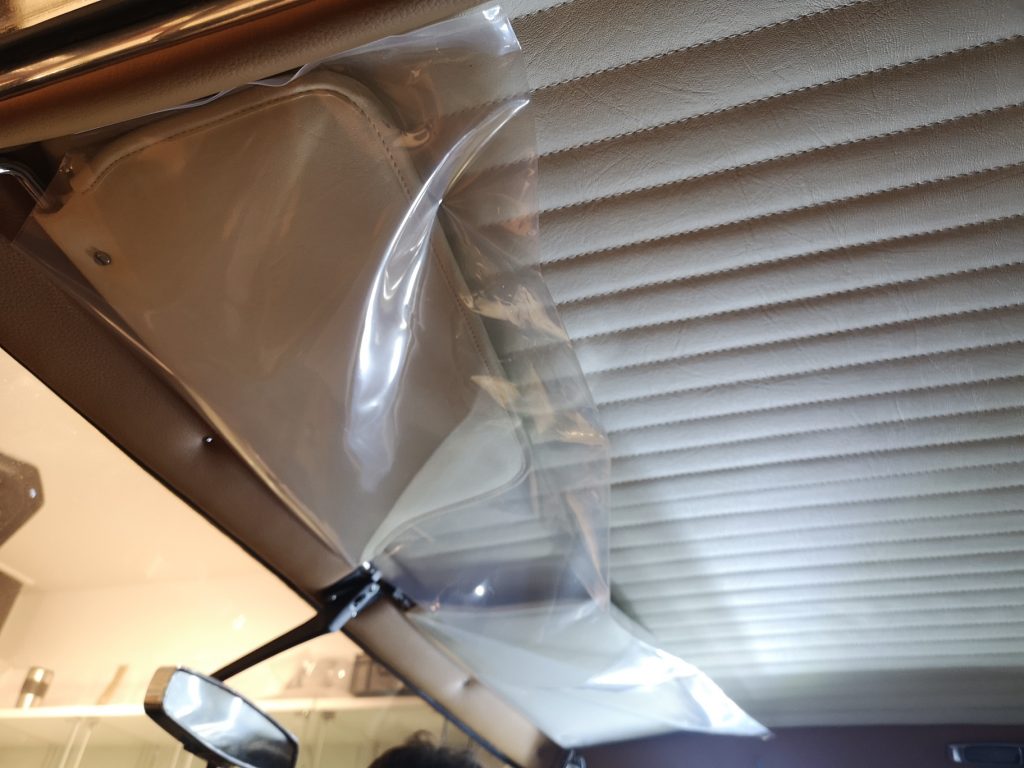
Replaced headlining, and recovered sun visors.
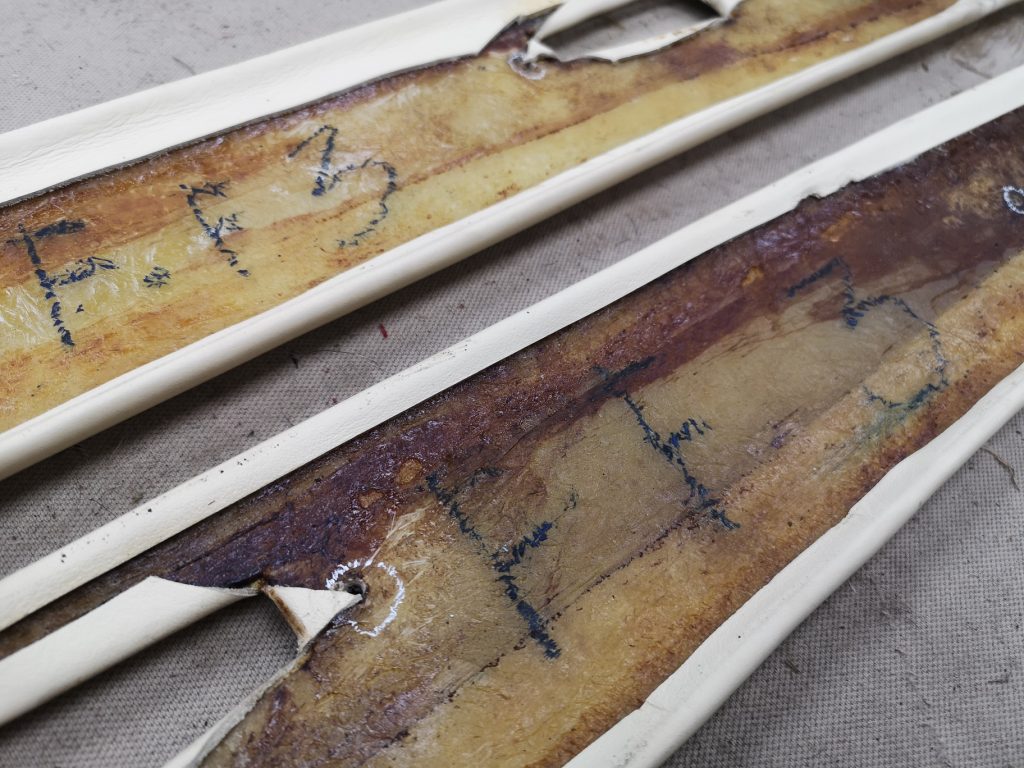
The interior roof panel side rails. Made in fibreglass, and with Vignale’s ‘FF 3’ designation.
Work continued, including changing the headlining, and the side rails, along with the back shelf, and fibreglass roll-bar cover. Other pieces still to be finished were the glove box assembly and rear cubby hole sections.
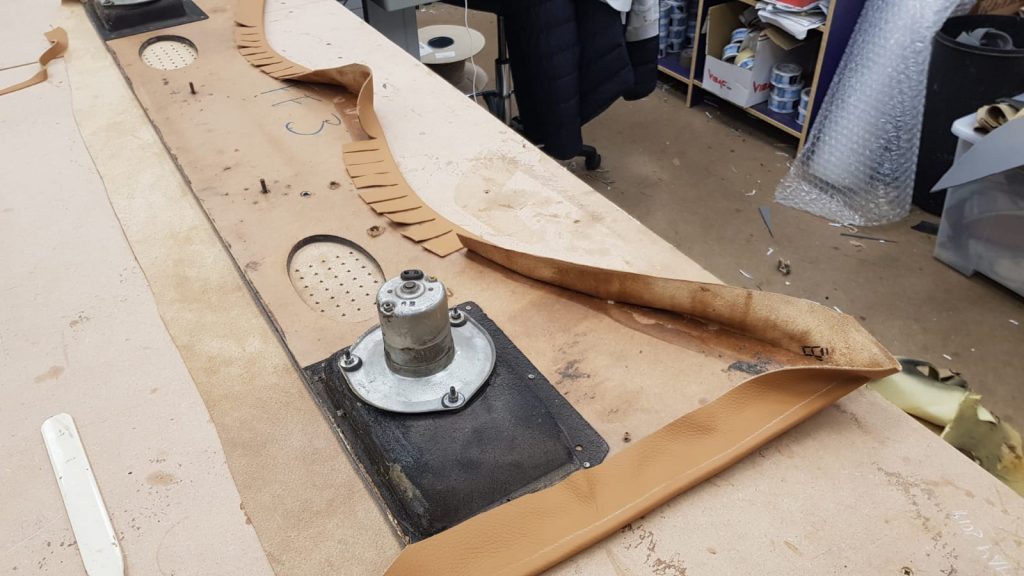
The back shelf being retrimmed. seen from the underside, shows the ‘FF 3’ marking to the centre. To the outside each end is the fan motors that blow air to the tailgate glass. Just inside from the fan motors are the speaker holes. Note the holes to the rear shelf by the speaker hole. Those same holes can be seen on the original tan leather shelf, before it was retrimmed in the 1990s (see image below).
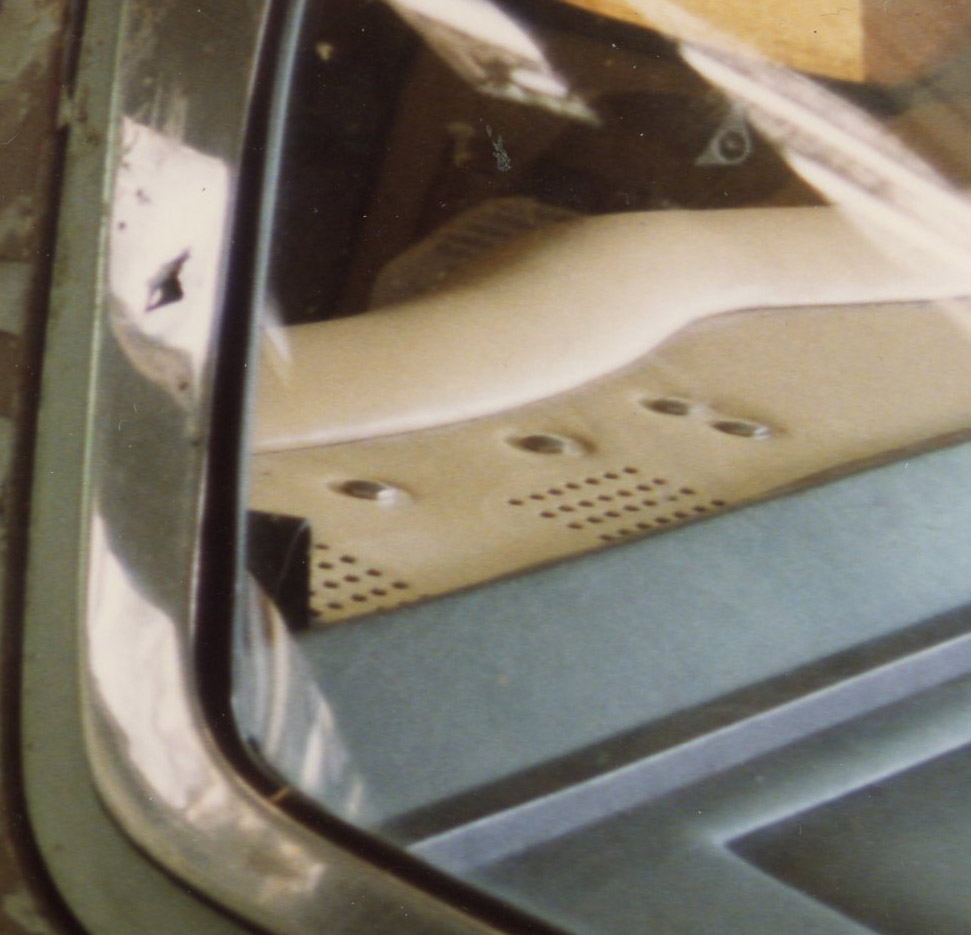
A view in on the rear shelf. The photo taken from when 119/004 was being restored in 1992. At this stage the original tan trim was still insitu. Note the chrome anchor points probably for a child’s safety belt, fitted into the rear shelf by a previous owner. Those same holes can be seen on the original board during the retrim (see image above).
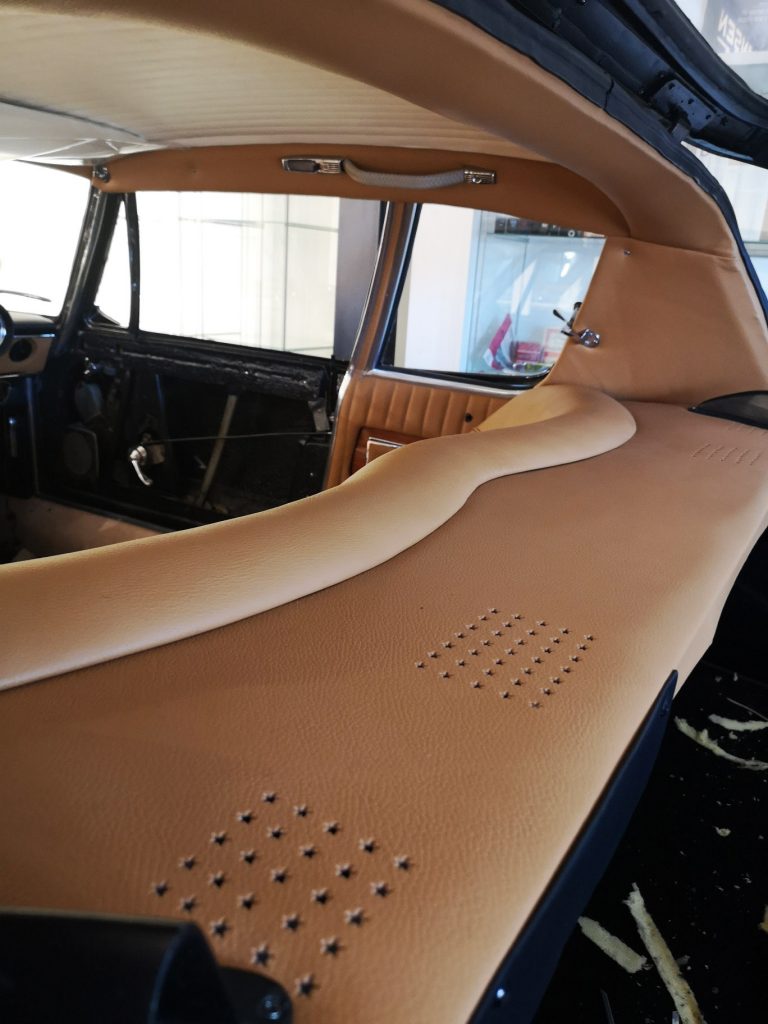
The back panel in place with correct punched star holes. The black Vignale fibreglass demisters can also be seen screwed to the panel. When production moved to West Bromwich, Jensen changed these in favour of a heated rear rear tailgate glass.
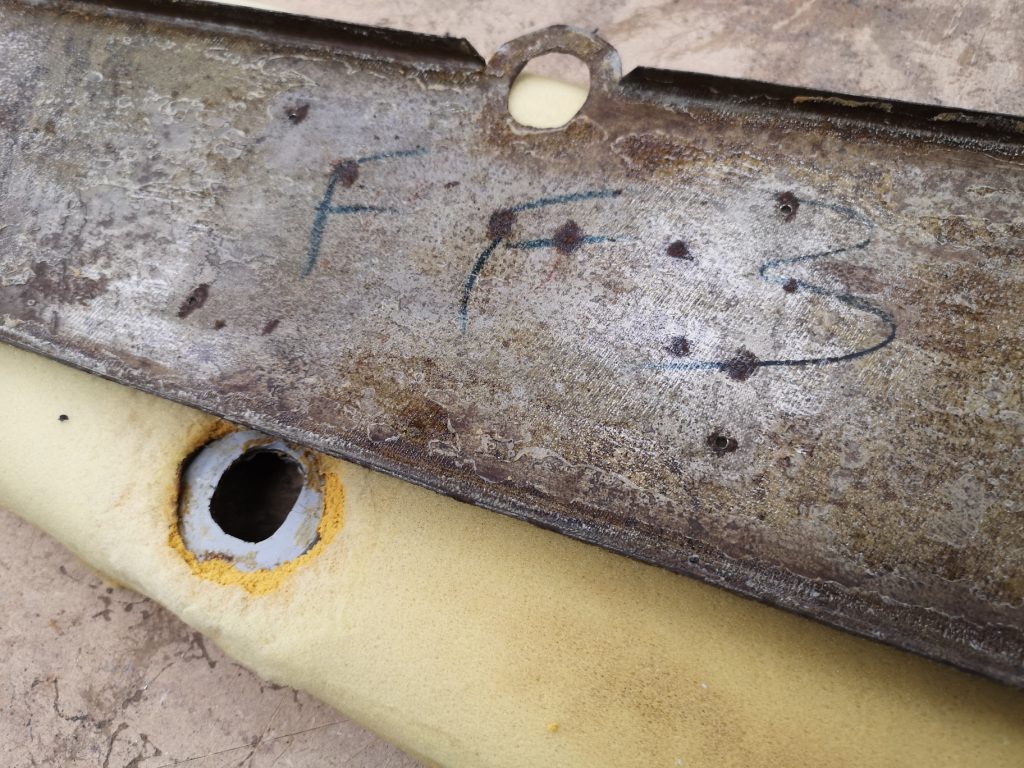
The cubby hole lid, along with the steel inner section marked ‘FF 3’. Although not easily noticeable, there are four small screw holes, which when covered, is where the main cubby hole specification / data plate is affixed.
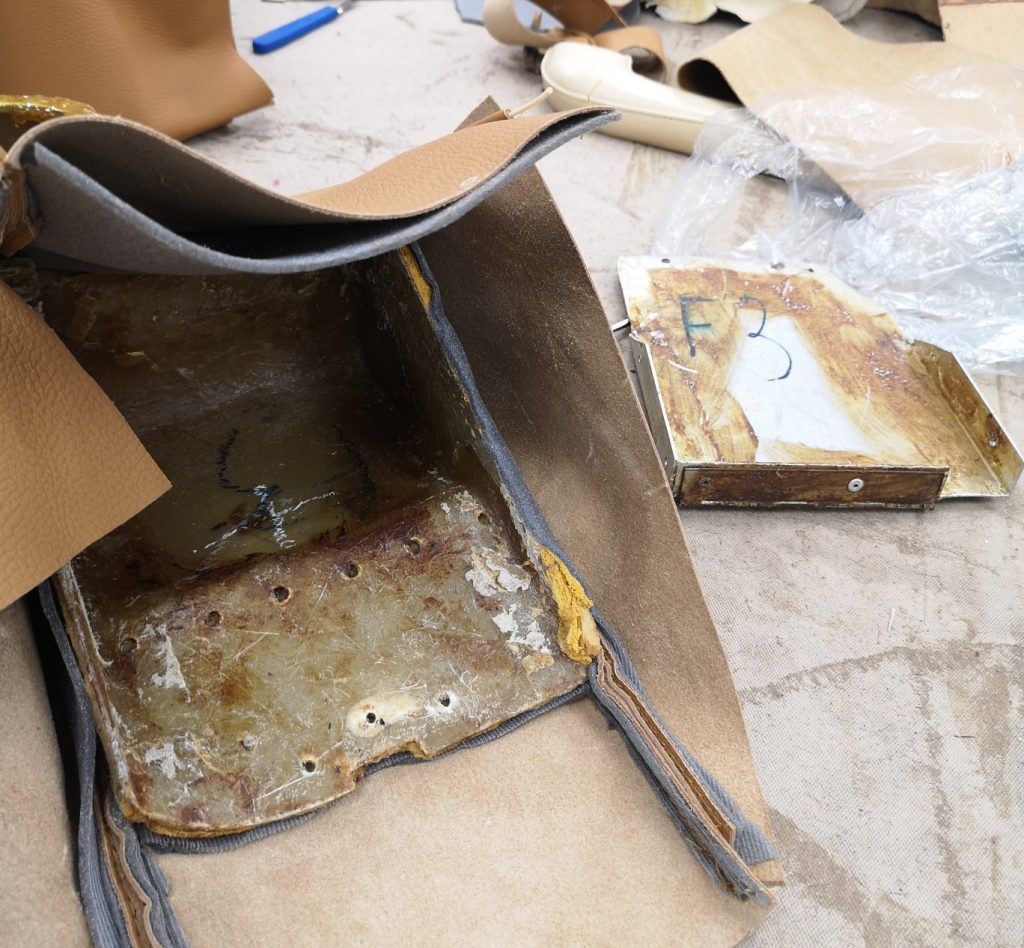
One of the rear cubby hole tops being retrimmed. Both the fibreglass upper shell, and the aluminium insert, were marked ‘F 3’. Both Vignale, and later on, Jensen Motors, would do this, if the part was relatively small. It was easier to mark it ‘F’ 3′, rather than ‘FF 3’.
As the trimming moved forward, new underlays, of a type as close as possible to that used by Vignale, were fitted in place, and work was also starting on the carpet set.
It wasn’t long before the back seat and front seats were the only parts left to retrim.
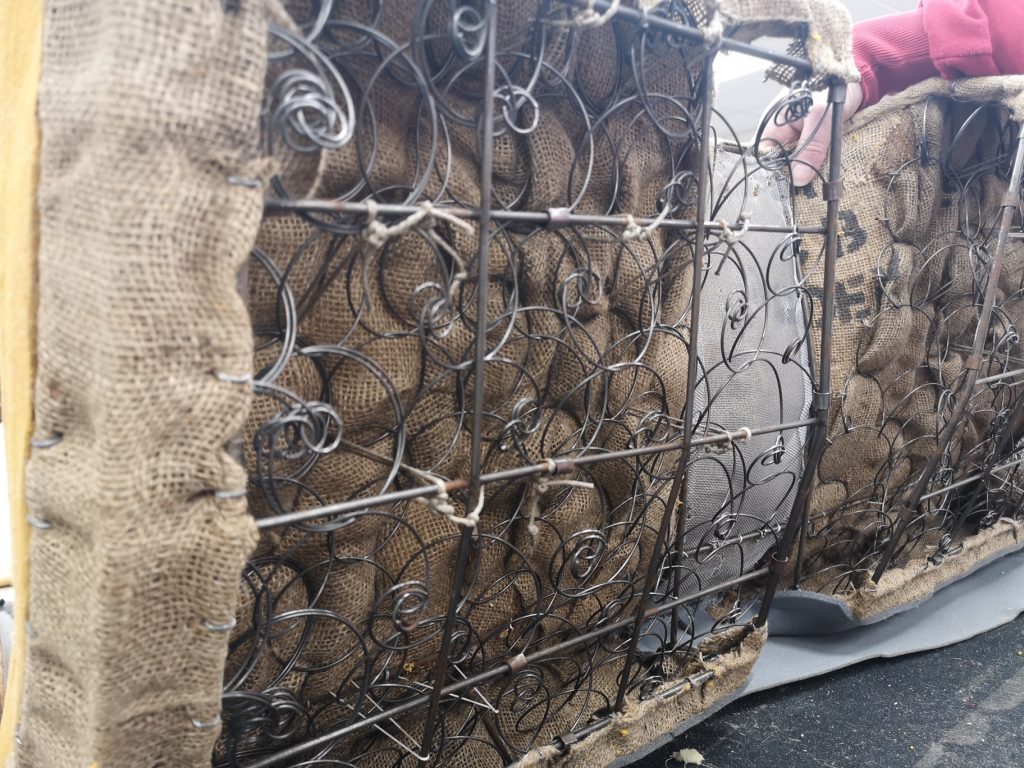
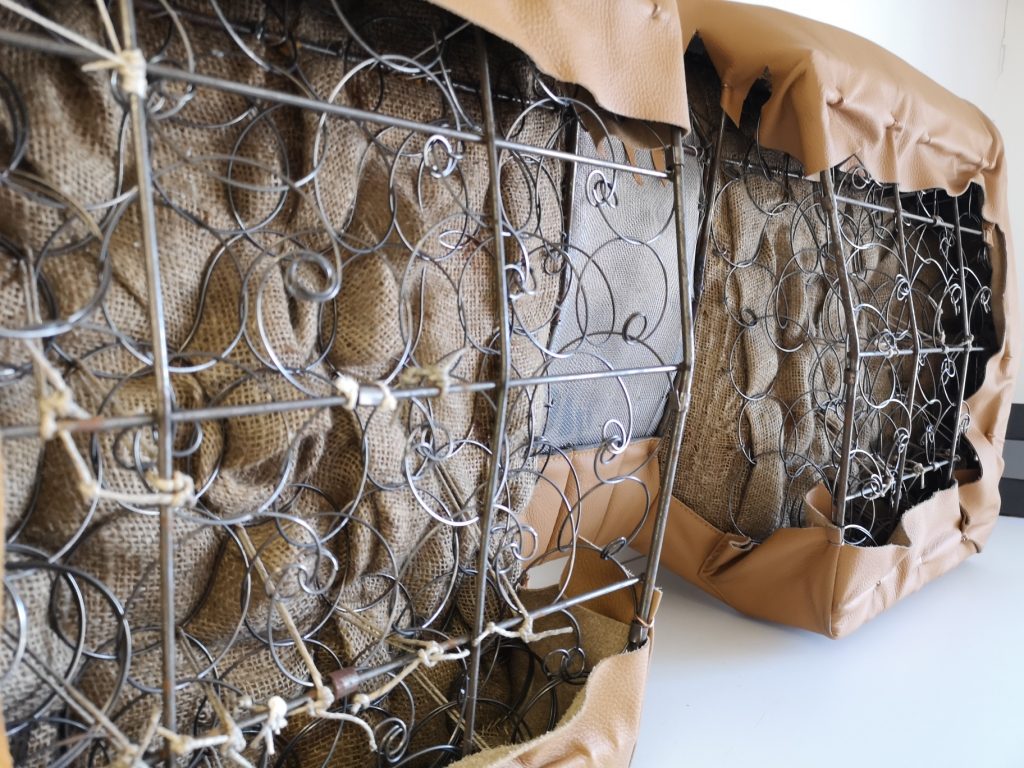
Underneath the rear seat, showing the springs, and typical sacking type material used by Vignale. This was retained, and is finished off with a section of brushed cotton material.
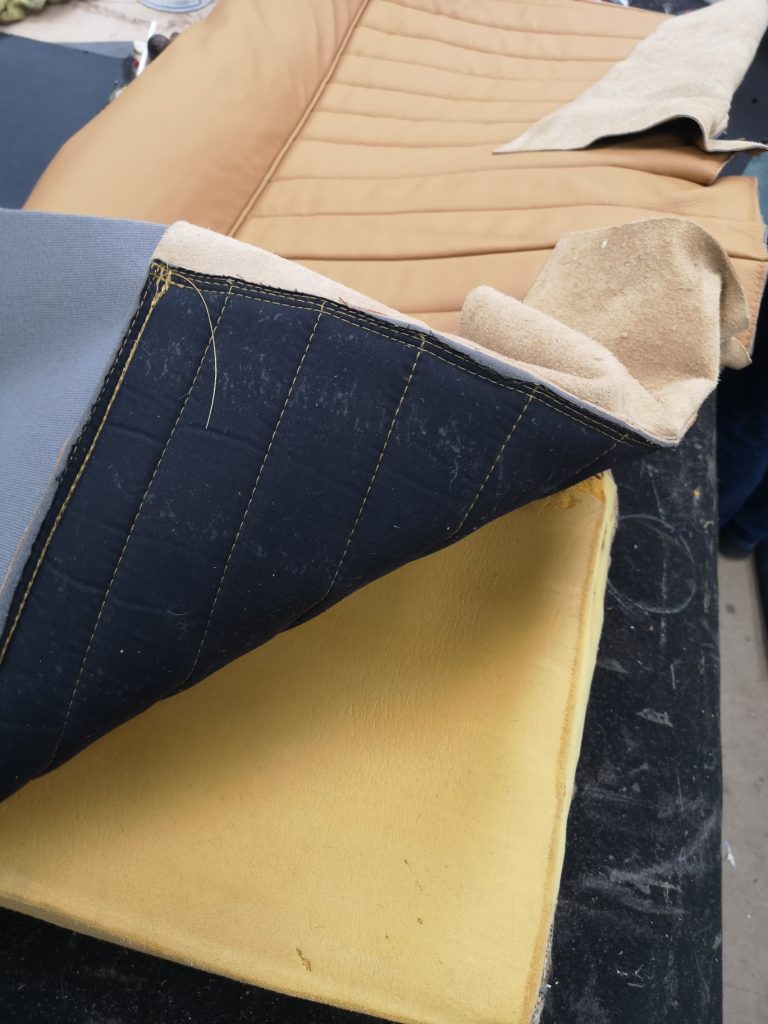
With a couple of new sections of sponge, the tan leather section is ready to be pulled into place and fastened.
The rear seat with the tan leather pulled into position, and fastened underneath. Its now ready for the back brushed cotton finishing material.
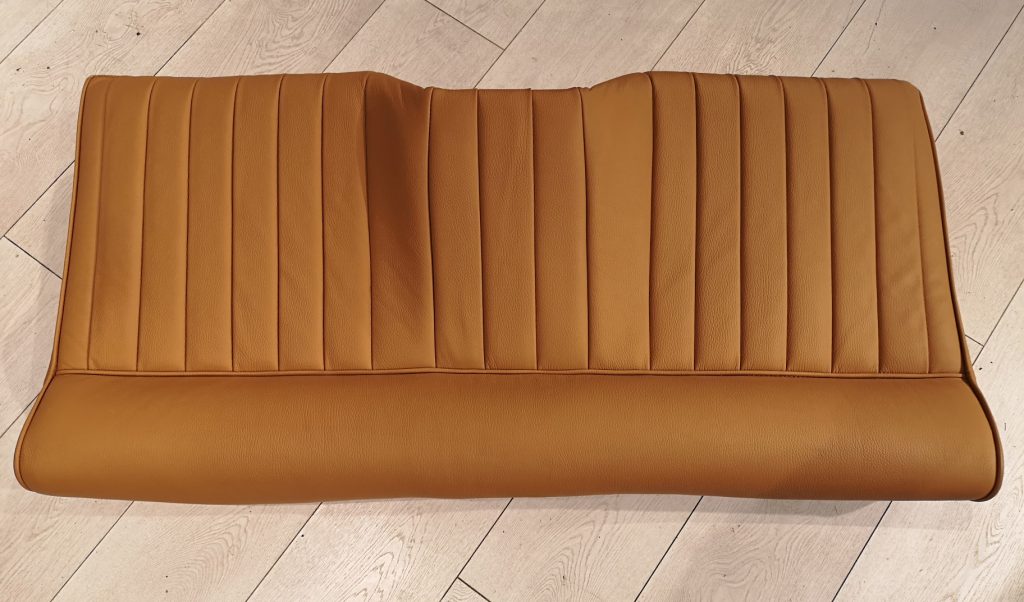
The completed rear seat section.
With the back seating finished, its time to start on the two front seats. With the magnolia leather removed, the trimmers found that the seats remained largely untouched.
Ward had placed some additional panels of a powder blue coloured sponge over the original seat foams. With these removed, a large Italian ink stamp was found. The foams were stamped by the manufacturer, and the designation states, ‘DO NOT EXPOSE TO LIGHT WITHOUT A COVER’. The original foams were left in place, and a new top finishing put on ready for the fitting up of the tan leather tops.
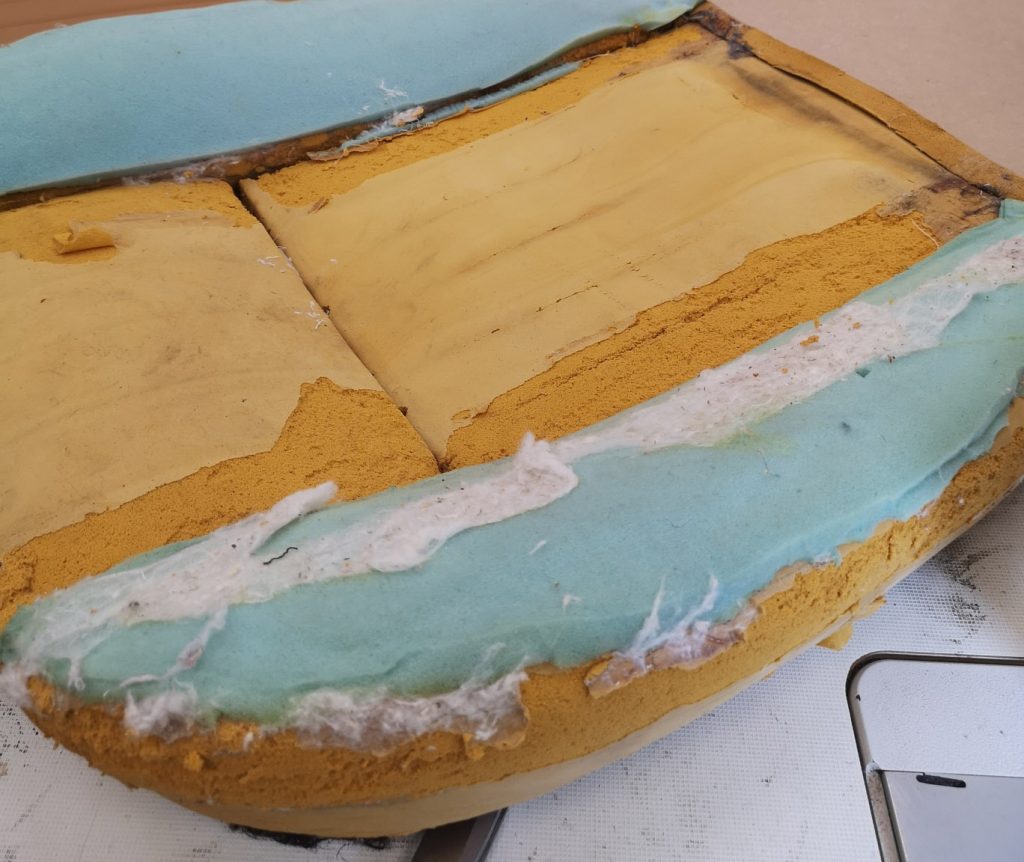
The original driver-side front seat base. This is the original mustard colour foam used by Vignale. Eric Ward has fitted a blue sponge top layer to bolster up the shape. This would be removed by Rejen’s trimmers, and a more sympathetic covering put on instead
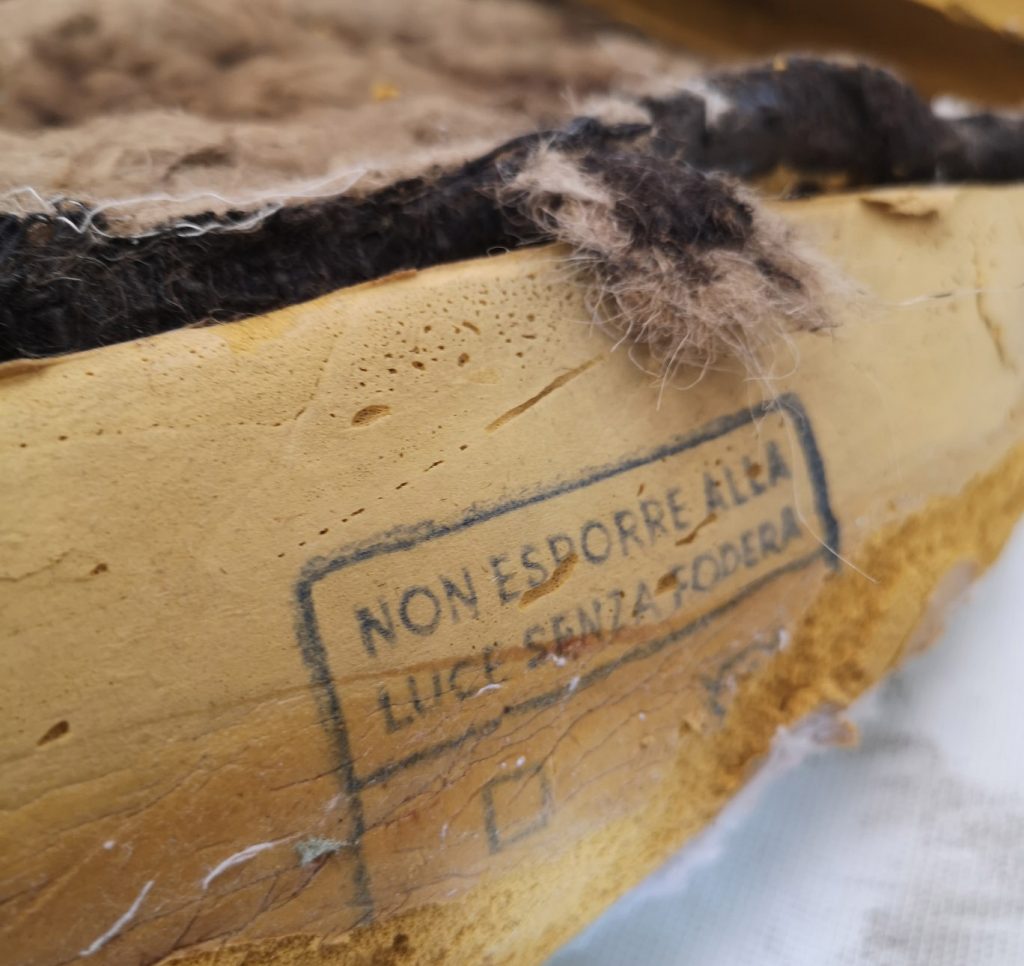
A large ink stamp to the side rubber of the front seat bottom section. The wording states, ‘Do not expose to light without a cover’.
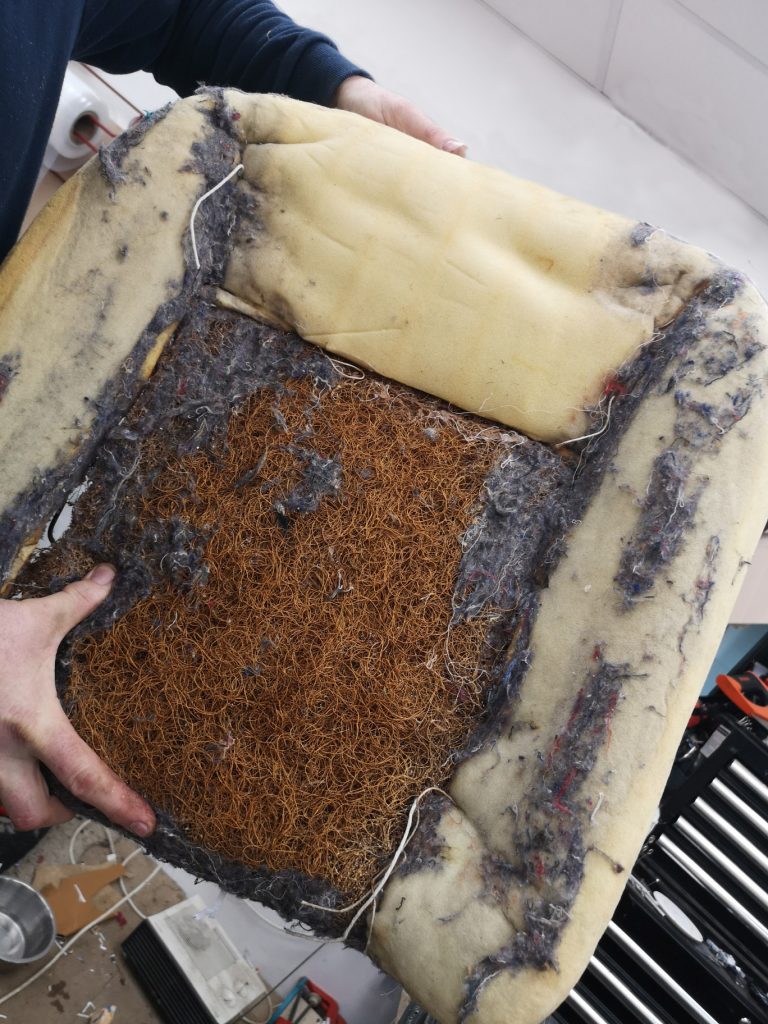
One of the front seat backs. Magnolia leather removed, along with the over covering to the foam, put on by Ward. The remaining foam and coconut husk filling is all Vignale’s work.
Jensen FF Chassis 119/004 | The Italian Job | Completion
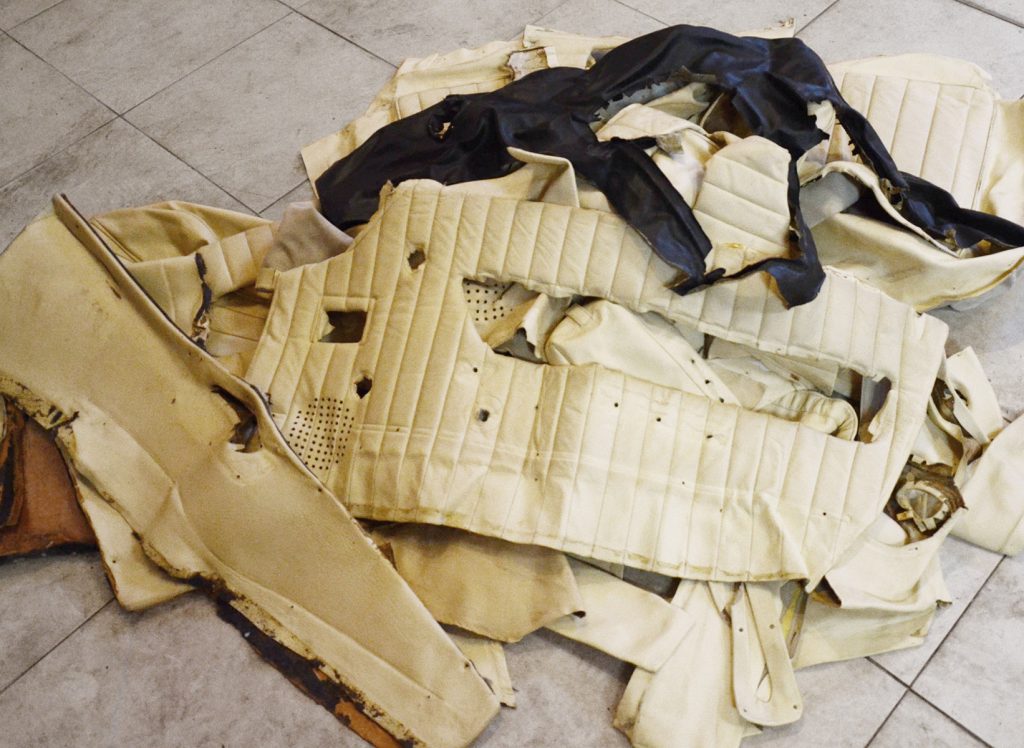
A pile of the old 1992 trim out of 119/004. The old door trim on the top of the pile, along with the old black vinyl from the dashboard.
By April 2021, the trim work to 119/004 was nearing completion, with just final inspection and snatch lists to be done. It had been a long journey to transform this interior successfully.
But, the halted work, and the completion of the Vignale trimmed 117/2606 car – before any work started to 119/004 – had been tremendously advantageous.
Without a doubt, the knowledge picked up by Rejen’s trimmers, when re-trimming the Vignale trimmed 117/2606 interior, led to a far more sympathetic re-trim to 119/004. Perfection requires patience, and 119/004 has ended up a far more perfect car because of it.
Truly a homage to Vignale’s trimmers.

Looking towards the driver seat.

An overall view of the interior.
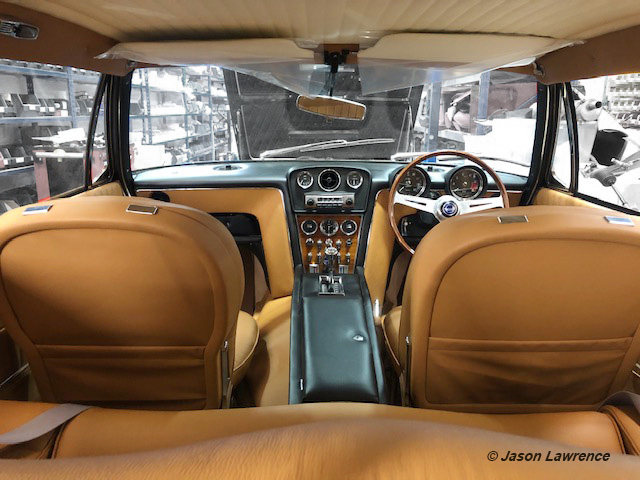
Looking in from the rear.
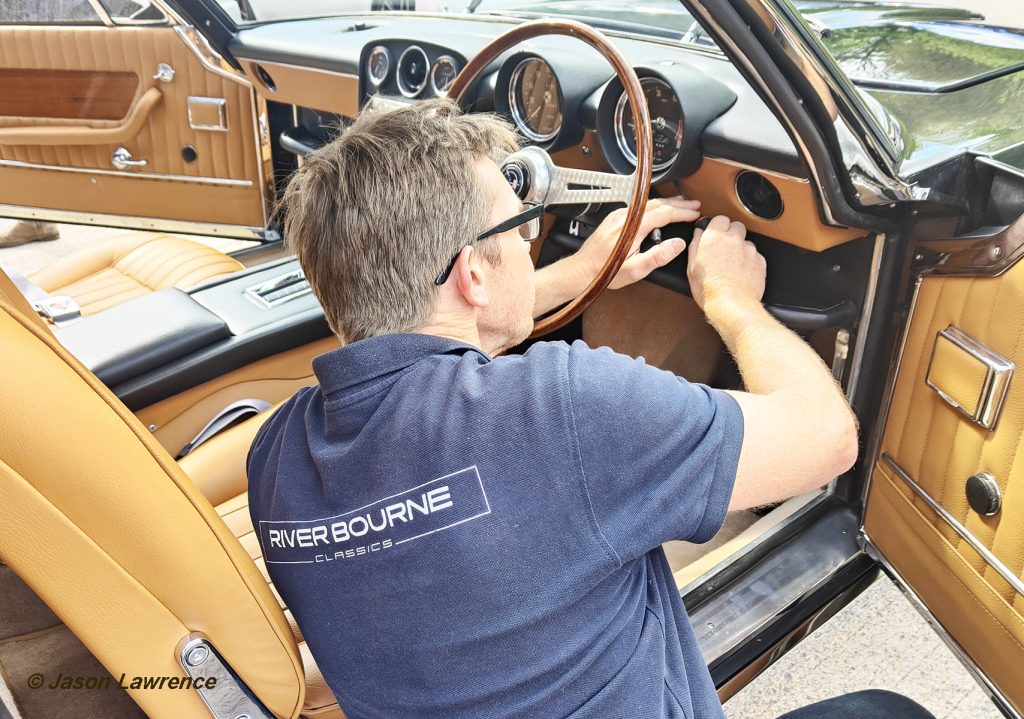
Jason Lawrence undertakes some final fettling to 119/004, before the car is given back to the Museum.
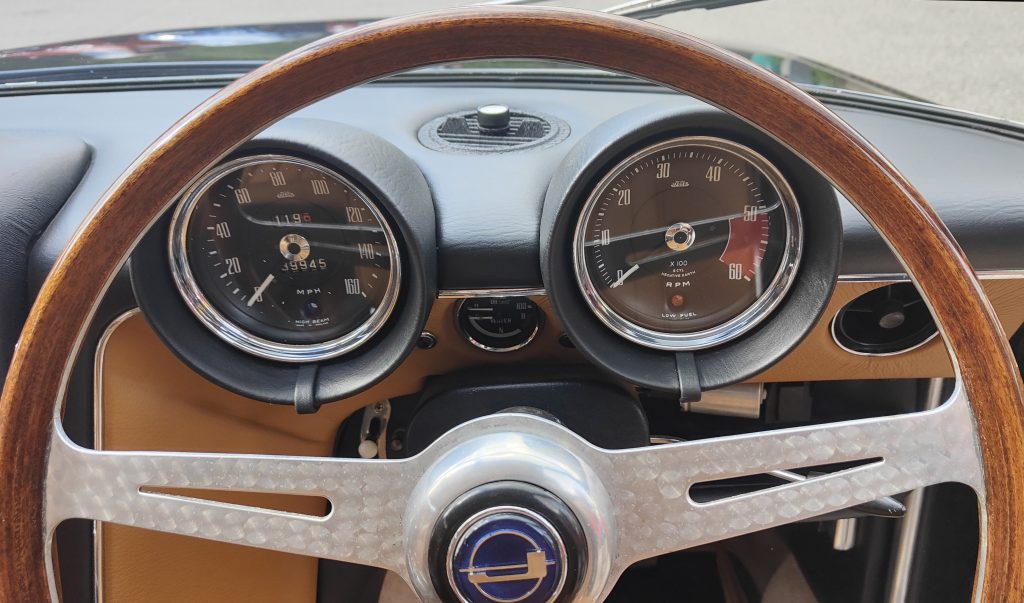
The small black vinyl covered sections to the bottom of the binnacles, is just one of numerous Vignale nuances which the Museum had put back in place. The vinyl strips are wrapped around wafer thin aluminium, and screwed into place under the binnacle. Vignale did this to cover up the sew lines.

View of the interior from the passenger side.
Jensen FF Chassis 119/004 | The Italian Job
ACKNOWLEDGEMENTS: Jason Lawrence, Rejen / Riverbourne Classics | Phil Cliff, Chapman & Cliff
COPYRIGHTS: The Jensen Museum | Jason Lawrence, Rejen / Riverbourne Classics
ADDITIONAL INFORMATION: If you have any additional information about this feature, please contact us at archive@jensenmuseum.org or telephone on: +1694-781354
We hope you have enjoyed this feature.
If you would like notification of when new features are added to the Museum website, then why not subscribe.
It’s free, and takes just a couple of minutes. Simply press the Subscribe to our mailing list link below.