
To this day , the CV8 FF remains shrouded in mystery. In part this is due to a 1990s failed scam to build, and pass-off a CV8 FF, using a later FF chassis. The story of the events leading up to the creation of the CV8 FF is something of motoring legend, but the mystery surrounding the car continues.
New information from former staff of Harry Ferguson Research, and Ferguson-Formula historian, Bill Munro, has helped the Museum to unravel the story of Jensen’s four-wheel-drive CV8. There still remains unanswered questions about the CV8 FF era, and the Museum hopes that answers will be found in the fullness of time.
Jensen CV8 FF | A Revolutionary Car | Early Talks

Richard Jensen

Tony Rolt
Through Richard Jensen’s old friend, Tony Rolt, the Jensen brothers were kept up-to-date with ongoing work at Harry Ferguson Research. The new Company had been set up in 1950, with the idea of licencing their four-wheel-drive system to major car manufacturers.
Although there had been much interest in what HFR were doing, no major contracts came their way. Meanwhile, HFR were creating their own prototype cars with four-wheel-drive systems – the ‘R’ series. In quick succession the Company moved from R1, to R2, to R3, and R4 which was built up in 1954, and eventually to the now famous R5.
After Harry Ferguson’s death in 1961, his son-in-law, Tony Sheldon, took over the Company. Sheldon and Rolt were looking at moving their prototype four-wheel-drive car into production, since they couldn’t get a major car company on board.
Sheldon thought that Jensen might able to make a sports car bodied version of their ‘R’ prototype, and to this end discussions probably took place with Richard Jensen. That said, it’s known that HFR also entered into discussions with Leyland. Alvis, were also contacted, with the idea of them building the engines, and Jensen possibly as the sub-contractor for the bodies for Leyland.
With all these ideas moving around the HFR boardroom, Richard Jensen was undoubtedly kept in the picture. HFR’s ideas of going into production with their ‘R’ prototypes faultered. It was probably down to a reality check by Sheldon, when working on costings of the project.
Meanwhile, Richard Jensen – who by the early 1960s had been given the chance to test-drive one of the ‘R’ prototypes – had come up with his own idea. Having discussed it with his brother, Alan, Richard Jensen put forward that Jensen Motors would like to licence the four-wheel-drive system, and build production four-wheel-drive CV8s.
Jensen CV8 FF | A Revolutionary Car | Working Towards An Agreement
Sheldon, and Rolt liked the idea, and entered into an informal agreement. Initially, Sheldon and Rolt offered Jensen Motors a Teramala transmission, this possibly being in the form of the Ferguson project P119, the Parallel Path system. This system had the advantage of being compact, and required the engine to be mounted offset, and with the flywheel forward.
However, since there wasn’t any agreement between HFR and any manufacturer to make this transmission, Jensen chose to use the TorqueFlite 3-speed automatic that was engineered for the Chrysler V8, and already in the CV8.
As such HFR would need to design a new type of transfer case, along with a centre adapter section to fit to the Torqueflite. That said, the idea of an offset engine was adopted.
Before Jensen Motors and Harry Ferguson Research could enter into a formal agreement, a CV8 needed to be given over to HFR to test the viability of their four-wheel-drive system working in a CV8.
To this end it was decided to give the original CV8 prototype car ‘261 FEA’ (chassis number JM/EXP/103), to Harry Ferguson Research. They would then adapt the car, fit and trial the four-wheel-drive system. In 1963, the grey coloured CV8 was sent to Ferguson, and work started to fit the system in place.
The Ferguson Projects ledger stated “P102 – CV8 FF project. 4WD installed in 261 FEA.” A sub-section to the ‘P102’ section in the Projects Ledger, was ‘P102M’. this was for the additional development work to fit a Maxaret system to the car.
It was Brian Spicer from Jensen Motors’ Development Department, that would work together with HFR’s Chief Draughtsman, Keith Hamilton Smith, and to that end Spicer would spend his time commuting between the Jensen works, and the HFR works in Coventry.

Brian Spicer

Keith Hamilton Smith
For the two men, the easiest part of the job was locating the driven front axle. The Chrysler engine sat back from centre line of the CV8’s front wheels, so there was sufficient room to place a driven axle in front of it.
The newly designed transfer case was bolted onto the back of the transmission, separated by a short adapter casing. The drive from the transfer case was stepped sideways to the left in order for it to align with the offset diff of the front axle, and this was achieved by using a chain drive in a housing integral with the transfer case.
At this time, HFR were using a transfer box with a triple staggered Renolds chain in their current ‘R’ prototype. Ferguson-Formula historian, Bill Munro is convinced this system was never used in the CV8 FF, Munro tells us more,
” Claude Hill had wanted to use the triple roller Renolds chain drive he had designed for R5/2, but in the spring of 1963, on advice given to Keith Hamilton Smith by EC Turner of Borg-Warner’s factory at Letchworth, a triple row of Borg-Warner’s new Morse Hy-Vo chains were used instead. A part of the problem was concerns of mating the Renolds chain system up with a big V8 engine. Particularly as the largest engine HFR had tested it with, was with their 2.2 Boxer engine.”
Munro believes an early version of Morse “Hy-Vo” chains was used, since HFR were already developing that system, while they were working on the Jensen. The new system proved to be simpler, and therefore cheaper, and better still, it was quieter in operation.
It was also a more robust system in comparison to triple staggered Renolds chain, and therefore better suited to Jensen’s V8 engine. Certainly, when this transfer box was tested in the prototype Oldsmobile Toronado, it was clearly robust enough to take the power coming from that heavy V8 vehicle.
Apparently Kevin Beattie had concerns this initial transfer box would still be too weak for Jensen’s V8 engine, and pushed for triple chains to be fitted. The concerns, and request for triple chains had been made direct to Tony Rolt, who thought that Beattie’s request was over-kill. It seems Beattie had his way, as a set of three Morse “H-Vo” chains went into the initial transfer box.
When the transfer boxes went into production, they did, however, drop back to using two chains. Had Rolt finally persuaded Beattie that two chains were more than strong enough for the Jensen. Perhaps that, and the fact it would make the production units cheaper did finally persuade him.

The initial transfer box as fitted to JM/EXP/103. The box would under-go some changes when it went into production.

Production transmission and transfer box. The production transfer box had a modified casting with horizontal fins at the back, and a separate casting for bolting the Maxaret control unit into place.
Because the transfer case was located behind the transmission and the chain case extended to the left hand side, the side of the CV8’s transmission tunnel had to be extended into the passenger foot-well to provide room for it.
Bill Chatterton from HFR remembers that, Jimmy Walker, HFR’s development engineer, was mainly responsible for the conversion of the Jensen braking system to include the Dunlop Maxaret,
” He was a fine practical engineer with little formal technical training, a man I was pleased to assist when necessary, and I guess my previous six years in vehicle brake system design at Girling was an asset. In fact my only test driving of the CV8 was with Jimmy at MIRA, where we used the wet and dry test surfaces to find the optimum Maxaret system settings.”
The standard CV8 front suspension needed to be changed, since the design needed to accommodate the front axle shafts. The re-designing of the front suspension took place during 1964, and the new suspension, which included two shock absorbers within coils, both sides, was fitted into place.
After much alteration to 261 FEA, Harry Ferguson Research had completed their work to the CV8 FF, the months had quickly passed by, and it was now late 1964. But at least HFR, and Jensen Motors were happy that the FWD system could work within the CV8.
Jensen CV8 FF | The Agreement
Kevin Beattie was kept informed of progress, and by late 1964, it was agreed by both Companies, that the system could work in the CV8. Now the ‘legal boys’ had to pen the licensing agreement, ready for the company heads to sign. The Agreement was outlined as specific licence to build cars more than 3.5 litres using the Ferguson-Formula.

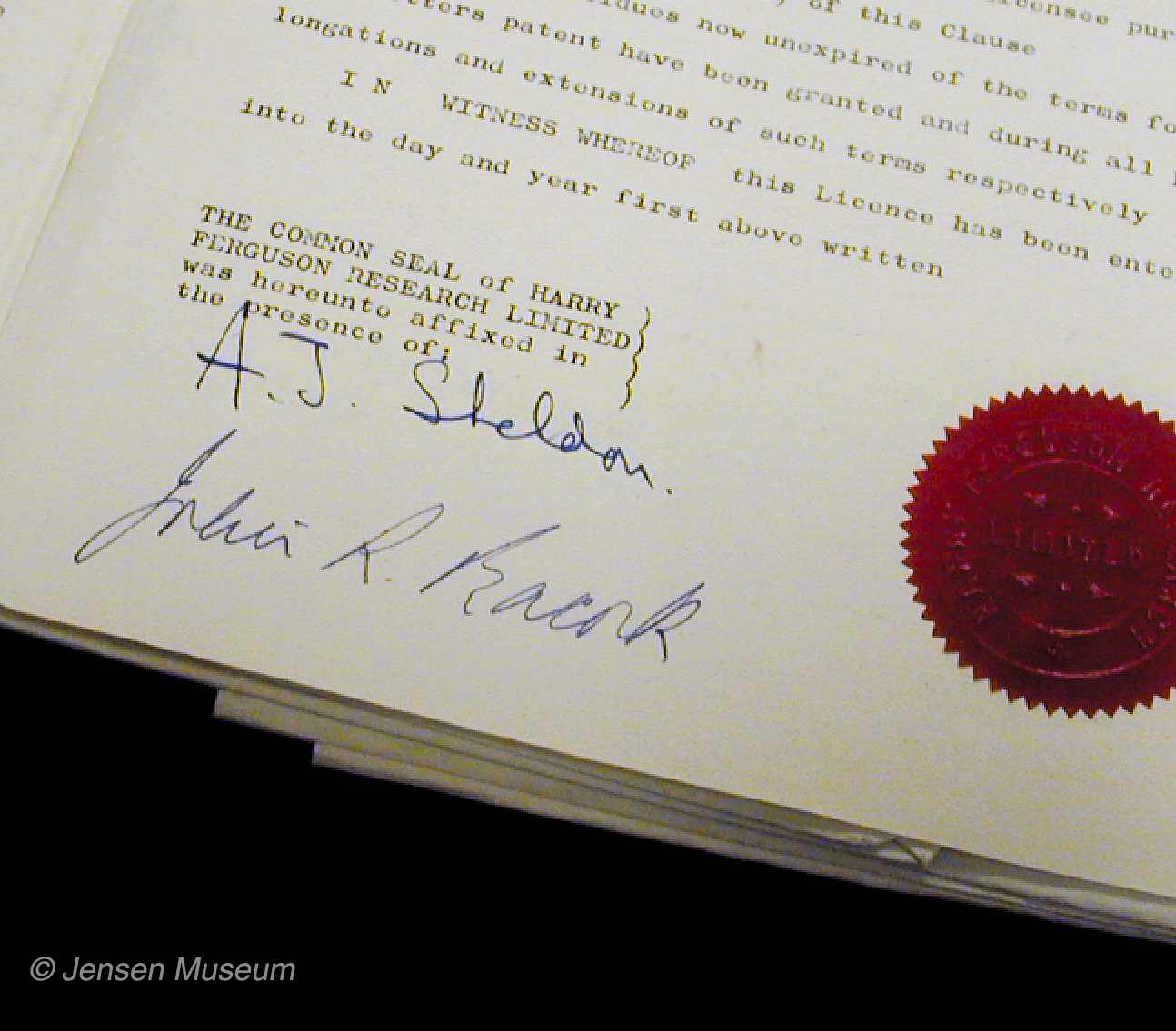

On the 31st December 1964, Richard Jensen, Brian Owen, Kevin Beattie and Len Fernley left Jensen Motors bound for Harry Ferguson’s headquarters. Arriving at Harry Ferguson Research, the ‘Jensen’ men were greeted by Tony Sheldon, Tony Rolt and John Peacock.


Richard Jensen, Brian Owen, Kevin Beattie, and Len Fernley


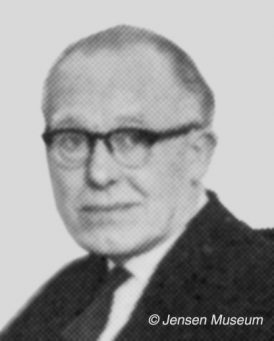
Tony Sheldon and Tony Rolt. The Museum hasn’t managed to find an image of John Peacock so far.
As the group sat around the board room table, it was left for Richard Jensen and Len Fernley to sign the Agreement on behalf of Jensen Motors Ltd.
Tony Sheldon and John Peacock signed on behalf of Harry Ferguson research Ltd. It must have been a special moment for all present, but especially for Richard Jensen.
He had dreamt of a Jensen four-wheel-drive production car, and this moment was bringing that dream closer. The Agreement was a formality, since back at Jensen Motors the drawings for a Jensen FF were already completed.
Jensen CV8 FF | Work Begins

The prototype CV8 (chassis number JM/EXP/103, registered as ‘261 FEA’, photographed before it went to Harry Ferguson Research.
What 261 FEA actually looked like when it was returned from HFR isn’t known, and so far no images have been found.
Former Jensen Motors engineer, Mike Jones, has a distant memory of the returned car to Development.
Although Jones’ recollections might be blurred by time, it does give an impression that the car returned was very much as a work in progress,
” I think it had a grey body, but with no bonnet, and virtually no trim or electrics, so I suppose it could be called a ‘mule’. The vehicle was not legally roadworthy, with no license plates, so Kevin Beattie and I were only able to have a short drive around the Kelvin Way factory ‘roads’. I believe it was scrapped shortly afterwards, as I did not see it again. My main involvement at the time was with Sunbeam Tiger.”
It is interesting that Jones remembers the FF ‘Mule’ as a grey vehicle, as this recollection is also confirmed by Bill Chatterton (ex-HFR), who remembers it was a grey prototype that he tested at MIRA.
With ‘261 FEA’ back at Jensen Motors in January 1965, it was time to start getting the car prepared for the 1965 Motor Show. The Non-Productive ledger for 1965 gives job number 639, Body Engineering Department were told to remove the body from 261 FEA and modify it as required once they were given over the modified chassis.
Meanwhile, with the body removed, the chassis was given over to the Chassis Engineering Department. This is also shown in the Non-Productive ledger for 1965, as job number 640. The department were instructed to convert 261 FEA as the first prototype FF. This led to the chassis being slightly lengthened to allow more room for the front axle. The lengthening between wheelbase went from 105″ to 109″ – 4″ longer.
More importantly, Kevin Beattie had already recognised the chassis of the Jensen 541 – with its perimeter rather than inboard main tubes – would make an excellent basis for the FF’s new chassis design. This had helped to speed up completion of drawings.
If this work had already been dealt with at HFR, or if it formed a part of the new work to what was now JM/EXP/110 (JM/EXP/103 was technically scrapped, and the job re-numbered as JM/EXP/110), isn’t absolutely clear at this stage. However, by the time the revised chassis was finished within the first half of 1965, the chassis had the additional length, also the perimeter chassis tubes.
The evolution of JM/EXP/103 through to JM/EXP/110 implies that Development used the JM/EXP/103 chassis, cutting it up as necessary and modifying it. However, even although the Non-Productive states “modify existing chassis,” there is also the possibility that work to modify the JM/EXP/103 chassis was considered too extensive, and that it was literally scrapped, in other words, Development started fresh, building a new purpose built chassis.
For Development, it was always going to be about the quickest and easiest way to get the job done. That said, using the existing chassis would probably have still made sense to the time-sensitive Development Department . At least the bulkhead was built up, the rear area for the seats, and so on, and so forth.
Since the new CV8 FF was going to be in the spot-light at the Motor Show, a good bright colour scheme was wanted. Carmine red was the final colour agreed for the car, along with a traditional black leather interior.
Interestingly, the Non-Productive ledger gives us further information about the CV8 FF. Job number 751, states modify vehicle to accept doors with electric window lift mechanisms, and wiring for switches.
The job number is dated May 1965, which shows work must have been progressing well by this stage. Interestingly the CV8 FF would be the first Jensen to have electric windows.
Work on the new four-wheel-drive prototype car would carry on over the coming months. However, Spicer and all those concerned with the project, were aware the finished car was required for an October (Motor Show) deadline.
Management at Jensen Motors were keen to have the revolutionary new four-wheel-drive Jensen on display at the October 1965 Earls Court Motor Show. The CV8 FF – priced at £5249.7s.1d (including purchase tax) – was certain to create public interest.
The new four-wheel-drive CV8 FF looked remarkably similar to the standard two-wheel-drive CV8, but had a longer front to accept the four-wheel-drive system and front differential.
The longer front wings had large grilled air intakes to the sides, a practise which was to continue on both the Italian designed Interceptor and FF. Special badges consisted of just one chromed metal ‘FF’ fitted to the front, and another to the rear panel of the car.
Jensen CV8 FF | Motor Show Debut
As October loomed, the prototype FF was still undergoing final finishing. As was often the case at Jensen Motors, the car was completed in the nick of time. Although ready for the show, there had been no time left for any initial testing of the car, road testing would have to wait until after the show.
In fact former HFR employee, Bill Chatterton, believes the car wasn’t drive-able when it was brought to the motor show. Although his memory of why the car wasn’t drive-able at that stage is blurred, he thinks it related to the transfer box. Perhaps an issue had developed with this initial transfer box.
Jensen Motors had asked HFR if they had a couple of their engineers that could be on the Jensen stand, to discuss anything particularly technical in regard to the FWD system.
HFR were happy to oblige, and two of their best design draughtsmen, Bill Chatterton, and Bill Simpson, were made available to help out on the Jensen stand at the 1965 Motor Show. Tony Rolt is also known to have visited the Jensen stand to see how things were going.
The new CV8 FF painted in gleaming carmine red, and finished with black leather trim, certainly created interest at the show, both with the public and the motoring press. The staff on the Jensen stand had a busy time, explaining the new four-wheel-drive concept and handing out a huge number of brochures.
Throughout the days of the show, the CV8 FF bonnet was open more than it was closed. Brochures for the FF had been printed in time for the show, but since the actual carmine red car wasn’t finished at the time of printing the brochures, a photograph of a conventional two-wheel -drive CV8 had to be used. At least the text would create the interest,


“Jensen FF– It is not a new car. It is a new kind of car. Under the sleekly power packed lines of the Jensen CV8, is the formula for the future. The Jensen FF. Once again Jensen Motors are first to lead the way towards finer cars – but this time the innovation is a gigantic step into the future, even by Jensen standards.
The Jensen FF with it’s revolutionary 4-wheel drive and aviation developed anti-skid braking system, blends speed and safety as never before. Here is a car which can be driven as no car has ever been driven. The Jensen FF opens a new era in motoring – an era of faster, safer driving. Driving the Jensen FF is an electrifying experience. It gives the motorist comfort, relaxation and a new kind of confidence.”

The new Jensen CV8 FF at the 1965 London Motor Show

The P66 in the foreground, with the distinctive CV8 FF side grille visible in the background.

The CV8 FF on call for a photo-shoot. Of interest is the toe-rope discreetly attached to the suspension underneath the car. This piece of evidence supports Chatterton’s memory that the CV8 FF wasn’t drive-able at the time of the motor show. incredibly, it meant Jensen had two ‘dead’ cars at the show, the CV8 FF, and the P66.

The carmine red painted CV8 FF photographed on the Jensen Stand at the 1965 Motor Show.

BBC motoring correspondent, Raymond Baxter, discusses the CV8 FF with celebrity, Brian Rix.

Public and media attention was focused on the CV8 FF, at the 1965 Motor Show – completely over shadowing the ill-fated P66.
The Jensen FF was positioned near the ill-fated Jensen P66 convertible car. The Jensen brothers, along with the then Chief Engineer, Eric Neale, were keen to have the P66 put into production, and had decided on reviving the name ‘Interceptor’ for this model.
Both Brian Owen, the Managing Director of Jensen Motors, along with Deputy Chief Engineer, Kevin Beattie, believed the way forward was to have a new car styled in Italy.
Meanwhile, the company proudly displayed the new FF technology under the skin of the old CV8. The public and motoring press, were definitely impressed with the four-wheel-drive concept, oblivious to the arguments which had been going on within the board room of Jensen Motors.
Throughout the days of the Motor Show, interest in the hastily finished convertible P66 had been totally overshadowed by the FF.
A former employee of Jensen Motors Ltd had unknowingly started a myth about the FF, which was to endure for two decades. He stated to Jensen historian, Keith Anderson, that the FF had not been finished in time for the Motor Show, and when placed on the stand, the car lacked the engine along with gearbox/four-wheel-drive unit.
According to the employee a large sandbag had been placed to the front sub-frame to keep the car at the correct height, and the bonnet stayed firmly closed throughout the show.
This myth was perpetuated in both the book, ‘Jensen Interceptor’ by Mike Taylor (published 1983), and in ‘Jensen & Jensen Healey’ by Keith Anderson (published 1998).
The fact was, the FF was complete (but not in a drive-able state) and spent most of its time with the bonnet raised. The P66 was the car which was not finished in time – lacking its drive-line – the car had a sandbag placed to the front cross member. The bonnet remained closed for the duration of the show.
This was mentioned to curator, Ulric Woodhams, by David Millard, the Service Manager at Jensen Motors, in September 2004, and was confirmed by Brian Spicer, Chief Engineer at Jensen Motors, in April 2005.
With the show over, the FF underwent thorough road testing and evaluation.
Final checking to make sure the car was safe for road testing took until the end of November, and JM/EXP/110 was registered with the licensing department on 7th December 1965. The allocated registration number was ‘EEA 72C’.

The CV8 FF undergoing extensive testing post the 1965 Motor Show.

View of the CV8 FF engine-bay, showing the Maxaret unit squeezed in under the master-cylinder. By the time the car was being used for road testing, the standard black Chrysler air-filter had been put in place.
Spicer was the first to test the car and to make sure there were no major problems, afterwards Beattie put the car through its paces. Richard Jensen also had his chance to take to the wheel of his dream car.
Jensen CV8 FF | Pursuing Italian Design
With boardroom disagreements over the styling of a new Jensen car leading to victory for those in favour of Italian designs, Ghia, Touring and Vignale were invited to submit designs.
The Touring design was chosen, but unable to build the first cars, Vignale offered to build them. With the contract with Vignale signed in January 1966, a CV8 car along with its four-wheel-drive counterpart would be made ready for departure to Vignale.
But just before the CV8 FF was made ready for taking over to Vignale, the car was driven down to London in March of 1966. This revolutionary new car had won Jensen Motors the Don Safety Award, for the Company’s pioneering work with four-wheel-drive and anti-lock braking. Jensen Motors’ Managing Director, Brian Owen, also travelled down to receive the award.

Second from left: Stephen Swingler MP, Parliamentary Secretary to the Minister Of Transport. He presented the Don Safety Award to Brian Owen (standing furthest right).

The Don Safety Award. The photograph was taken at Jensen Parts & Service in 1981, by Museum curator, Ulric Woodhams.

S.G.Porter’s beautiful cutaway drawing of the CV8 FF, dating from 1965. Porter was asked by Autocar to draw the CV8 FF as a cutaway. Porter’s original survives in the Museum’s archive.
Jensen CV8 FF | Time For A New Body
Once back at Jensen Motors, work was needed to make the CV8 FF ready for Vignale. Spicer’s memory of events, is that it was necessary to take the glass-fibre body off the CV8 FF to make some modifications to the chassis ready for Vignale. However, this is looking increasingly unlikely.
It might be that Spicer’s memory was of the JM/EXP/103 body being removed, for modification of the chassis as the prototype FF. Once again, analysing the Non-Productive ledger, one finds a further two job numbers. 725 & 726 simply states, “Chassis 4WD – to build one production prototype chassis”, and “Body 4WD – to build one production prototype body”. Since the ledger also states these were not completed until April 1966, we know this was not the CV8 FF at the 1965 Motor Show.
Bearing in mind, even further on in the Non-Productive ledger, there are job numbers for the build of FF 2, FF 3 and so on, this makes it increasingly likely that these job numbers related to the creation of an all new build FF. In all probability, this was built as JM/EXP/113, and was the FF sent out to Vignale to have a steel-body fitted.
It was Bill Chatterton from HFR that unknowingly raised issues about JM/EXP/110 being modified to become JM/EXP/113, since within his diary from the time, he states he was test driving the CV8 FF at MIRA in May 1966.
It would just about be possible for that to happen, and then the car sent over to Vignale, but not if Spicer’s recollections were correct, and it was necessary for the body to come off, for modifications to take place to the chassis.
Based on Chatterton’s diary of events, and a fresh take on the Non-Productive ledger, it seems most likely, that JM/EXP/110 was retained by Development for further testing. Meanwhile, the additional FF chassis, which was completed by April 1966, was JM/EXP/113. This car was then sent out to Vignale in May 1966.
Jensen CV8 FF | Epilogue
By August 1966 JM/EXP/113 – now re-numbered for series production as 119/001 – was almost finished. It was agreed to air freight 119/001 from Turin to London Airport along with the second Interceptor ‘HEA 1D’.
Once at the Jensen factory, both cars were thoroughly checked over and prepared for the forthcoming Earls Court Motor Show in October 1966.
Ken Beauchamp, an Inspector at Jensen Motors remembers the arrival of the first ‘Italian’ FF at the Jensen factory,
“the ‘secret’ car was quickly moved to the Development section, away from the work force.”

Jensen FF chassis number JM/EXP/113, suitably re-numbered as 119/001, to set the car up as the first production FF. When 119/001 was built up at Vignale, Jensen hadn’t yet manufactured the JFF for the grille. The badge was fitted later at West Bromwich.
Once ensconced within the Development section, Spicer set about checking the FF over ready for road testing, as this car was to be used to demonstrate the new Jensen FF to the motoring journalists. The FF was registered with the local taxation department on the 16th September 1966.
But what of JM/EXP/110. On the 10th October 1966 Jensen Motors Ltd contacted the local taxation department, returning the tax disc and advising them that the car had been dismantled and the chassis destroyed.
Jensen CV8 FF | A Revolutionary Car
ACKNOWLEDGEMENTS: Ken Beauchamp, former Inspector, Jensen Motors |Richard Calver, Jensen Historian |Bill Chatterton, former Design Draughtsman, HFR | Richard Graves, former Marketing Director, Jensen Motors | Mike Jones, former Deputy Chief Engineer, Jensen Motors | Han Kamp, Jensen Historian | David Millard, former Service Manager, Jensen Motors | Bill Munro, Ferguson-Formula historian ||Brian Spicer, former Chief Development Engineer, Jensen Motors | John Staddon, CV8 Registrar, Jensen Owners’ Club | Shaun Winfield, Chairman, Jensen Owners’ Club
COPYRIGHTS: Jensen Museum | Han Kamp | Bill Munro
ADDITIONAL INFORMATION: If you have any additional information about this article, please contact us at archive@jensenmuseum.org or telephone on: +1694-781354
We hope you have enjoyed this feature.
If you would like notification of when new features are added to the Museum website, then why not subscribe.
It’s free, and takes just a couple of minutes. Simply press the Subscribe to our mailing list link below.